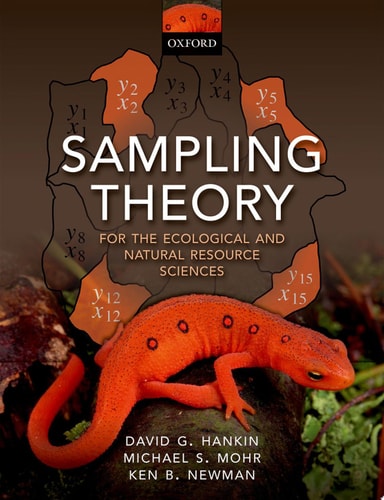
Sampling Theory: For the Ecological and Natural Resource Sciences
0
0
As an Amazon Associate and affiliate partner, Menrva Books earns from qualifying purchases. Learn more
Author Description
Sampling theory considers how methods for selection of a subset of units from a finite population (a sample) affect the accuracy of estimates of descriptive population parameters (mean, total, proportion). Although a sound knowledge of sampling theory principles would seem essential for ecologists and natural resource scientists, the subject tends to be somewhat overlooked in contrast to other core statistical topics such as regression analysis, experimental design, and multivariate statistics. This introductory text aims to redress this imbalance by specifically targeting ecologists and resource scientists, and illustrating how sampling theory can be applied in a wide variety of resource contexts. The emphasis throughout is on design-based sampling from finite populations, but some attention is given to model-based prediction and sampling from infinite populations. Sampling Theory is an introductory textbook suitable for advanced undergraduates, graduate students, professional researchers, and practitioners in the fields of ecology, evolution, conservation biology, and natural resource sciences (including fisheries, wildlife, rangeland, ecology and forestry).
Menrva's Summary
THE THESIS
This text investigates how the selection of subsets from finite populations influences the accuracy of statistical estimates within ecological and natural resource management contexts. The authors, David G. Hankin, Kenneth B. Newman, and Michael S. Mohr, provide a structured pedagogical framework designed to bridge the gap between theoretical sampling principles and practical field application. By focusing on design-based sampling, the book addresses the frequent oversight of these methods in standard statistical curricula for environmental scientists.
THE SCOPE MAP
What You Will Find
- Principles of design-based sampling from finite populations
- Applications for fisheries, wildlife, rangeland, and forestry management
- Comparative analysis of model-based prediction versus design-based estimation
- Methodologies for estimating population parameters such as means, totals, and proportions
Scope Limits
- Does not provide an exhaustive treatment of infinite population sampling
- Assumes a foundational understanding of basic statistical concepts
THE AUTHORITY PERSPECTIVE
Experts identify this work as a foundational resource for bridging the gap between abstract statistical theory and the specific requirements of field-based ecological research. Readers frequently note the technical clarity of the prose, which makes complex sampling methodologies accessible to both advanced students and practicing professionals in the natural sciences.
Page Count:
368
Publication Date:
2019-01-01
Publisher:
OUP Oxford
ISBN-10:
0192547844
ISBN-13:
9780192547842
Science
Mathematics Statistics
Statistical methods
Ecology
Mathematics - General
Statistics
textbook
Mathematics
Sampling statistics
Community Tags
Similar Books