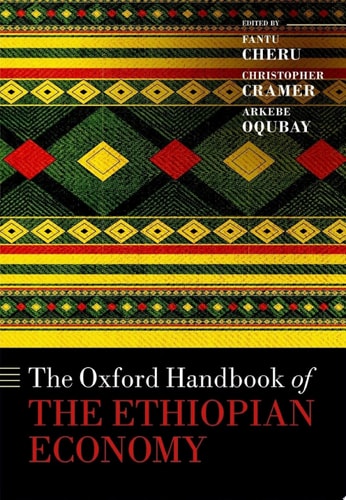
The Oxford Handbook of the Ethiopian Economy
0
0
As an Amazon Associate and affiliate partner, Menrva Books earns from qualifying purchases. Learn more
Author Description
From a war-torn and famine-plagued country at the beginning of the 1990s, Ethiopia is today emerging as one of the fastest-growing economies in Africa. Growth in Ethiopia has surpassed that of every other sub-Saharan country over the past decade and is forecast by the International Monetary Fund to exceed 8 percent over the next two years. The government has set its eyes on transforming the country into a middle-income country by 2025, and into a leading manufacturing hub in Africa. The Oxford Handbook of the Ethiopian Economy studies this country's unique model of development, where the state plays a central role, and where a successful industrialization drive has challenged the long-held erroneous assumption that industrial policy will never work in poor African countries. While much of the volume is focused on post-1991 economic development policy and strategy, the analysis is set against the background of the long history of Ethiopia, and more specifically on the Imperial period that ended in 1974, the socialist development experiment of the Derg regime between 1974 and 1991, and the policies and strategies of the current EPRDF government that assumed power in 1991. Including a range of contributions from both academic and professional standpoints, this volume is a key reference work on the economy of Ethiopia.
Menrva's Summary
THE THESIS
This volume investigates the mechanisms behind Ethiopia's rapid economic transformation and its unique state-led development model. Edited by Arkebe Oqubay, Christopher Cramer, and Fantu Cheru, the text synthesizes contributions from diverse academic and professional experts to evaluate how Ethiopia challenged conventional assumptions regarding industrial policy in developing nations. The work provides a comprehensive analytical framework for understanding the country's transition from a post-conflict state to a projected manufacturing hub.
THE SCOPE MAP
What You Will Find
- Historical analysis of the Imperial period, the Derg socialist regime, and the post-1991 EPRDF era
- Evaluation of state-led industrialization strategies and economic policy
- Comparative data on sub-Saharan economic growth trends
Scope Limits
- Does not provide real-time economic forecasting beyond the initial publication projections
- Focuses primarily on macro-level policy rather than granular micro-economic case studies of individual firms
THE AUTHORITY PERSPECTIVE
Experts identify this volume as a foundational reference work for scholars and policymakers interested in African development models. Readers frequently note the academic density of the prose, which provides a rigorous examination of Ethiopia's complex economic history.
Page Count:
999
Publication Date:
2019-01-01
Publisher:
OUP Oxford
ISBN-10:
0192546457
ISBN-13:
9780192546456
Economics
History
Reference
Africa
Developing Countries
Ethiopia
Economics history
Community Tags
Similar Books