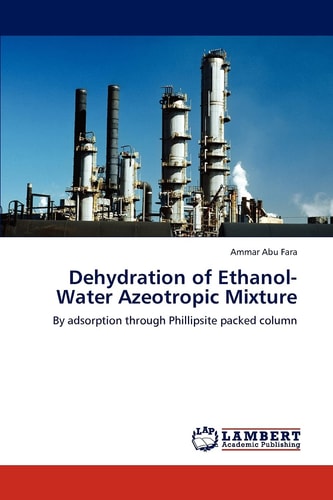
Dehydration of Ethanol-Water Azeotropic Mixture
0
0
As an Amazon Associate and affiliate partner, Menrva Books earns from qualifying purchases. Learn more
Author Description
The potential use of raw and activated phillipsite as well as calcium chloride salt for separating the ethanol water azeotropic mixture in the adsorptive distillation process was assessed in this book 4A molecular sieves was taken as a reference adsorbent to which the water adsorption on selected materials was compared. The breakthrough curves of water sorption on these adsorbents showed that the treatment of phillipsite with 1M calcium chloride (1M-phillipsite) produced the best separation of the ethanol water azeotropic mixture, where the breakthrough time is about 55 mins which is almost similar to the molecular sieves (57 mins).
Menrva's Summary
THE THESIS
This book investigates the efficacy of specific materials for separating the ethanol-water azeotropic mixture through adsorptive distillation. The research assesses the potential of raw and activated phillipsite, alongside calcium chloride salt, as adsorbents. It compares their water adsorption capabilities against a reference adsorbent, 4A molecular sieves. The study analyzes breakthrough curves to determine the separation performance of each material.
THE SCOPE MAP
- Evaluation of raw and activated phillipsite as adsorbents.
- Assessment of calcium chloride salt for separation.
- Comparison with 4A molecular sieves as a reference adsorbent.
- Analysis of water sorption breakthrough curves.
- Determination of breakthrough time for selected materials.
- Identification of the optimal adsorbent for ethanol-water azeotrope separation.
- Quantification of separation efficiency based on breakthrough time.
THE AUTHORITY PERSPECTIVE
The research presented in this book focuses on a specific chemical engineering problem: the separation of ethanol-water azeotropes. The methodology involves experimental assessment of various adsorbents, with a clear comparison to established materials like molecular sieves. The findings highlight the performance of a treated phillipsite material, suggesting its potential utility in industrial processes. The detailed analysis of breakthrough curves provides quantitative data for evaluating separation effectiveness.
Page Count:
72
Publication Date:
2012-01-01
Publisher:
Lap Lambert Academic Publishing GmbH KG
ISBN-10:
3848438259
ISBN-13:
9783848438259
Non-Fiction
Science
Adsorption
Water Treatment
Chemical Engineering
Community Tags
Similar Books