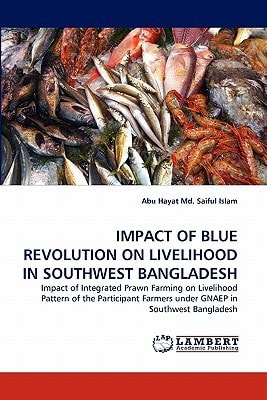
Impact of Blue Revolution on Livelihood in Southwest Bangladesh
0
0
As an Amazon Associate and affiliate partner, Menrva Books earns from qualifying purchases. Learn more
Author Description
This book was designed to examine the impact of integrated prawn (Macrobrachium rosenbergii) farming (so called blue revolution) under GNAEP in southwest Bangladesh. The study identified the socioeconomic profile, cost, return, profit, efficiency as well as livelihood status of the integrated prawn farmers. The study used logit and stochastic frontier profit function for investigating the livelihood impact and profit efficiency of integrated prawn farmers (IPF) respectively. It is evident that the mean profit efficiency of IPF was about 90.36 per cent. The yield of prawn and cost of seedlings/post larva influence positively and the costs of labour, fertilizer, feed, land use and irrigation cost affect negatively to profit of IPF. Age, education, sex and training of respondents had significant influence on profit efficiency of IPF. It was found that IPF has brought positive changes in different aspects of livelihood such as human, social, natural, financial and physical capital, food intake, and woman empowerment. Production and marketing problems of IPF was also identified. Finally, based on the findings of the study, some recommendations were made.
Menrva's Summary
THE THESIS
This book investigates the economic and social ramifications of integrated prawn farming, termed the 'blue revolution,' in the coastal regions of Southwest Bangladesh. The study examines the socioeconomic profiles of integrated prawn farmers (IPF), analyzing their costs, returns, profit efficiency, and overall livelihood status. Employing logit and stochastic frontier profit function analyses, the research quantifies profit efficiency at approximately 90.36%, identifying key factors influencing profitability such as prawn yield, seedling costs, and various operational expenses. The findings demonstrate that this farming model has positively impacted human, social, natural, financial, and physical capital, alongside improvements in food intake and women's empowerment.
THE SCOPE MAP
- Analysis of the socioeconomic profile of integrated prawn farmers in Southwest Bangladesh.
- Detailed examination of cost, return, and profit calculations for integrated prawn farming.
- Application of logit and stochastic frontier profit function for efficiency analysis.
- Quantification of profit efficiency for integrated prawn farmers.
- Identification of factors positively and negatively influencing profit.
- Assessment of the impact on human, social, natural, financial, and physical capital.
- Evaluation of changes in food intake and women's empowerment.
- Identification of production and marketing challenges faced by farmers.
THE AUTHORITY PERSPECTIVE
The study provides a detailed quantitative analysis of the 'blue revolution' in Southwest Bangladesh, focusing on integrated prawn farming. It highlights significant positive impacts on various aspects of farmer livelihoods, including capital assets and social indicators like food intake and women's empowerment. The research also identifies key operational challenges and offers recommendations based on its findings. The methodology, employing logit and stochastic frontier profit functions, suggests a rigorous approach to assessing economic efficiency and impact.
Page Count:
140
Publication Date:
2010-11-01
Publisher:
Lap Lambert Academic Publishing GmbH KG
ISBN-10:
3843371326
ISBN-13:
9783843371322
Non-Fiction
Science & Technology
Economics
Socioeconomics
Aquaculture
Bangladesh
Community Tags
Similar Books