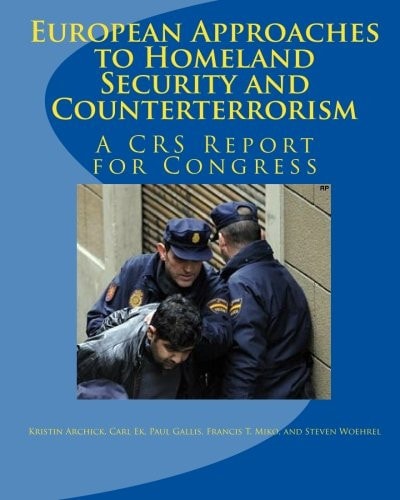
European Approaches to Homeland Security and Counterterrorism: A CRS Report for Congress
0
0
As an Amazon Associate and affiliate partner, Menrva Books earns from qualifying purchases. Learn more
Author Description
This report examines homeland security and counterterrorist measures in Belgium, France, Germany, Italy, Spain, and the United Kingdom. The approaches of many European countries to protecting their publics and infrastructure have grown out of decades of experience in dealing with domestic terrorist groups. None of these European countries currently has a single ministry or department equivalent to the U.S. Department of Homeland Security. In most, responsibility for different aspects of homeland security and counterterrorism is scattered across several ministries, and inter-governmental cooperation plays a key role in addressing threats. In the UK, Germany, and Belgium, responsibility for homeland security affairs is also split among federal and regional or state governments. Originally published by the Congressional Research Service.
Menrva's Summary
THE THESIS
This report investigates the diverse strategies employed by key European nations in their efforts to safeguard their populations and critical infrastructure against terrorism. It details how Belgium, France, Germany, Italy, Spain, and the United Kingdom have developed their approaches, often drawing from extensive experience with domestic terrorist organizations. The report highlights a common theme: the absence of a single, overarching department akin to the U.S. Department of Homeland Security, with responsibilities typically distributed across multiple ministries and reliant on inter-governmental collaboration. Furthermore, it notes the division of homeland security affairs between federal and regional or state governments in countries like the UK, Germany, and Belgium.
THE SCOPE MAP
- Analysis of homeland security and counterterrorism measures in Belgium, France, Germany, Italy, Spain, and the United Kingdom.
- Examination of how decades of experience with domestic terrorist groups have shaped European approaches.
- Comparison of European governmental structures for homeland security versus the U.S. model.
- Identification of the distribution of responsibilities across various ministries in European countries.
- Emphasis on the crucial role of inter-governmental cooperation in addressing terrorist threats.
- Discussion of the split responsibilities between federal and regional/state governments in specific nations (UK, Germany, Belgium).
THE AUTHORITY PERSPECTIVE
This report, originally published by the Congressional Research Service, offers a comparative analysis of European counterterrorism and homeland security frameworks. Its detailed examination of governmental structures and historical context provides valuable insight into the operational challenges and collaborative strategies adopted by these nations. The report's focus on the decentralized nature of security responsibilities across various ministries and levels of government serves as a key takeaway for understanding international approaches to these complex threats. It is a factual resource for policymakers and researchers interested in the evolution of national security strategies.
Page Count:
52
Publication Date:
2006-07-09
Publisher:
CreateSpace Independent Publishing Platform
ISBN-10:
1448688736
ISBN-13:
9781448688739
Politics
Non-Fiction
History
Counterterrorism
Government Reports
Homeland Security
Community Tags
Similar Books