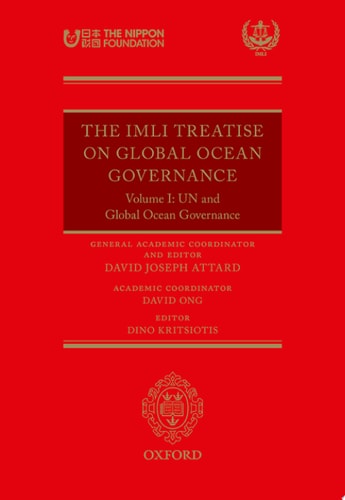
The IMLI Treatise on Global Ocean Governance
0
0
As an Amazon Associate and affiliate partner, Menrva Books earns from qualifying purchases. Learn more
Author Description
The 1982 United Nations Convention On The Law Of The Sea (unclos) Remains The Cornerstone Of Global Ocean Governance. However, It Lacks Effective Provisions Or Mechanisms To Ensure That All Ocean Space And Related Problems Are Dealt With Holistically. With Seemingly No Opportunity For Revision Due To The Conventions Burdensome Amendment Provisions, Complementary Mechanisms Dealing With Such Aspects Of Global Ocean Governance Including Maritime Transport, Fisheries, And Marine Environmental Sustainability, Have Been Developed Under The Aegis Of The United Nations And Other Relevant International Organizations. This Approach Is Inherently Fragmented And Unable To Achieve Sustainable Global Ocean Governance. In Light Of The Sustainable Development Goals (sdgs), Particularly Goal 14, The Imli Treatise Proposes A New Paradigm On The Basis Of Integrated And Cross-sectoral Approach In Order To Realise A More Effective And Sustainable Governance Regime For The Oceans. This Volume Focuses On The Role Of Un As The Central Intergovernmental Organization Responsible For Global Ocean Governance. It Examines The Ocean Governance Challenges And How The Present Legal, Policy, And Institutional Frameworks Of The Un Have Addressed These Challenges. It Identifies The Strengths And Weaknesses Of Un Legal Structures And Offers Tangible Proposals To Realize The Ambition Of A Global Ocean Governance System.
Menrva's Summary
THE THESIS
This volume investigates whether the current fragmented international legal framework, centered on the 1982 UN Convention on the Law of the Sea, can be reformed to achieve holistic and sustainable global ocean governance. The authors, led by experts from the International Maritime Law Institute, analyze the limitations of existing UN mechanisms in addressing complex maritime issues like fisheries and environmental sustainability. They argue that the current sectoral approach is insufficient to meet the Sustainable Development Goals, particularly Goal 14, and propose a new paradigm based on integrated, cross-sectoral cooperation.
THE SCOPE MAP
What You Will Find
- Analysis of the 1982 United Nations Convention on the Law of the Sea (UNCLOS) and its amendment limitations
- Evaluation of UN-led institutional frameworks regarding maritime transport and fisheries
- Proposals for an integrated, cross-sectoral governance model
- Assessment of the role of the UN as the primary intergovernmental coordinator
Scope Limits
- Does not provide a comprehensive history of all maritime treaties outside the UN system
- Focuses primarily on institutional and legal reform rather than technical marine biology or oceanography
THE AUTHORITY PERSPECTIVE
Legal scholars and policy analysts view this work as a significant contribution to the discourse on international maritime governance. Readers frequently note the academic density of the prose and the rigorous legal analysis provided by the contributors.
Page Count:
464
Publication Date:
2018-01-01
Publisher:
Oxford University Press
ISBN-10:
0192557467
ISBN-13:
9780192557469
Maritime law
Law
International relations
Community Tags
Similar Books