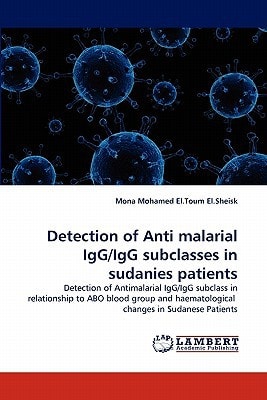
Detection of Anti Malarial Igg/Igg Subclasses in Sudanies Patients
0
0
As an Amazon Associate and affiliate partner, Menrva Books earns from qualifying purchases. Learn more
Author Description
Merozoite surface protein MSP2 is a vaccine candidate antigen of Plasmodium falciparum that is polymorphic in natural populations. In this study we aimed to investigate whether malaria infection in associated with anti-malaria specific IgG, using recombinant proteins derived from the two major allelic types of MSP2 and ABO blood group. The conclusion is the Higher anti-malarial IgG1, IgG3, IgG2 and lower levels of IgG4 were associated with reduced risk of malaria infection. IgG2 is activator of the classical complement pathway, Fc RIIa H131 is essential for handling IgG2 immune complexes. These data suggest that an MSP2 based vaccine should be designed to induce high level antibody responses against the different MSP2 types present globally in P. falciparum populations and that MSP2 could be combined with other P. falciparum antigens to form a multi-component malaria vaccine.
Menrva's Summary
THE THESIS
This study investigates the association between anti-malarial specific IgG and IgG subclasses and the risk of malaria infection in Sudanese patients. The research focuses on merozoite surface protein 2 (MSP2), a vaccine candidate antigen for Plasmodium falciparum, examining its polymorphic nature and its role in antibody response. The authors aimed to determine if specific antibody levels, particularly IgG subclasses, correlate with reduced malaria risk, utilizing recombinant proteins from major MSP2 allelic types and ABO blood groups to analyze these associations.
THE SCOPE MAP
- Analysis of anti-malarial IgG and IgG subclasses (IgG1, IgG2, IgG3, IgG4) in Sudanese patients.
- Investigation of the role of merozoite surface protein 2 (MSP2) allelic types in antibody response.
- Examination of the association between antibody levels and reduced risk of Plasmodium falciparum infection.
- Exploration of the potential of MSP2 as a vaccine candidate antigen.
- Consideration of ABO blood group in relation to malaria infection and antibody response.
- Discussion of IgG2's role in activating the classical complement pathway and Fc RIIa H131's importance in handling IgG2 immune complexes.
- Recommendations for designing an MSP2-based vaccine to induce broad antibody responses against global MSP2 types.
- Suggestion for combining MSP2 with other Plasmodium falciparum antigens for a multi-component malaria vaccine.
THE AUTHORITY PERSPECTIVE
The study presents findings on the immunological response to Plasmodium falciparum, specifically focusing on IgG antibodies and their subclasses in relation to malaria risk in Sudan. The research suggests that higher levels of IgG1, IgG3, and IgG2, alongside lower levels of IgG4, are associated with a decreased risk of malaria infection. These findings have implications for vaccine development, indicating that a successful MSP2-based vaccine should aim to elicit robust antibody responses against diverse MSP2 types and could potentially be enhanced by combining it with other parasitic antigens.
Page Count:
68
Publication Date:
2011-03-01
Publisher:
Lap Lambert Academic Publishing GmbH KG
ISBN-10:
384338178X
ISBN-13:
9783843381789
Non-Fiction
Science
Public Health
Parasitology
Immunology
Malaria
Community Tags
Similar Books