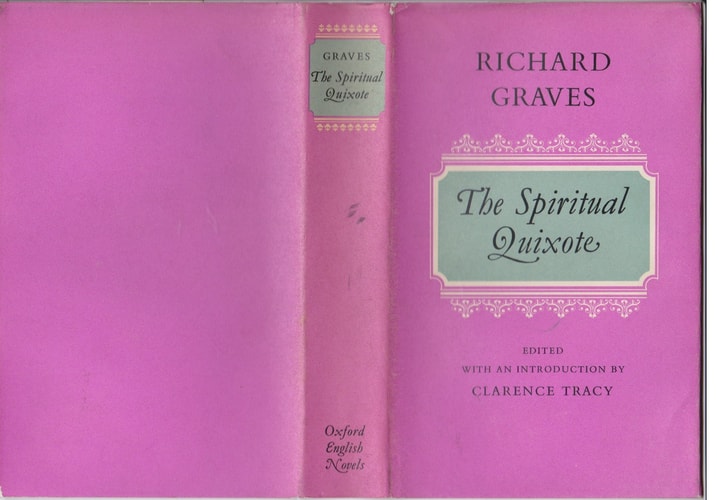
The Spiritual Quixote: Or the Summer's Ramble of Geoffry Wildgoose
0
0
As an Amazon Associate and affiliate partner, Menrva Books earns from qualifying purchases. Learn more
Author Description
The story of Geoffry Wildgoose's 'summer ramble' around Wales and the Midlands, accompanied by Jerry Tugwell, the village cobbler, in order to preach the doctrines of Methodism which he has lately embraced. As the title suggests, Richard Graves took Cervantes' 'Don Quixote' for his model, and just as its hero set out on an adventurous journey of hopelessly outdated chivalry, Wildgoose pursues an eloquent, if misguided, course of religious reform which leads him into a series of teasing and often ludicrous situations. Graves, who was educated at Pembroke College, Oxford, became a fellow of All Souls, and was rector of Claverton near Bath from 1794 to 1802, was extremely critical of the itinerant reformers whose methods he considered unenlightened. In this novel the 'ill-judged zeal of a frantic Enthusiast' is exposed to ridicule, and the intrusion of laity into spiritual affairs is attacked. There is a satirical portrait of Whitefield, the Methodist preacher, who was a contemporary of Graves at Oxford, and a host of carefully observed character sketches including a pleasant description of the poet Shenstone, a close friend of Graves. The plot itself is skillfully composed and provides a detailed and humorous picture of the social conditions of the time.
Menrva's Summary
THE PULSE
Geoffry Wildgoose, a man recently converted to Methodism, embarks on a rambling tour of the English countryside to preach his new faith, only to find his idealistic mission constantly undermined by his own naivety and the realities of the world. Accompanied by his pragmatic cobbler companion, Jerry Tugwell, Wildgoose attempts to emulate the fervor of itinerant preachers, yet he repeatedly encounters social friction and absurd misunderstandings. The narrative utilizes a picaresque framework, mirroring the structure of Cervantes' work to highlight the protagonist's misguided zeal. As Wildgoose moves through Wales and the Midlands, he faces logical constraints imposed by the rigid social hierarchies and religious tensions of the eighteenth century.
INSIDE THE PAGES
- Picaresque narrative structure modeled after Don Quixote
- Satirical critique of 18th-century Methodist itinerant preaching
- Episodic encounters with diverse social classes
- Inclusion of real-world figures such as George Whitefield and William Shenstone
- Use of irony to expose the protagonist's lack of self-awareness
- Detailed depiction of rural English social conditions
- Contrast between the idealistic protagonist and the grounded, skeptical sidekick
- Third-person omniscient perspective providing social commentary
THE COLLECTIVE ECHO
Readers and critics frequently identify this work as a significant example of 18th-century satirical fiction that effectively uses humor to address contemporary religious controversies. Discussion often centers on the author's ability to balance sharp social critique with the lighthearted, episodic nature of the protagonist's travels. Many highlight the effectiveness of the character dynamic between Wildgoose and Tugwell, which serves as the primary vehicle for the book's thematic exploration of zealotry versus common sense. The novel is widely recognized for its vivid character sketches and its historical value in documenting the social atmosphere of the period.
Page Count:
532
Publication Date:
1967-01-01
Publisher:
Oxford University Press
ISBN-10:
0192553100
ISBN-13:
9780192553102
Historical Fiction
Satire
Picaresque
Classic Literature
Community Tags
Similar Books