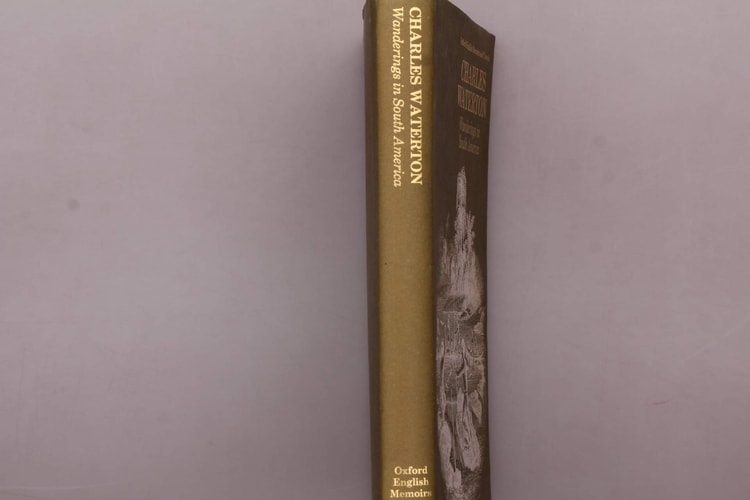
Wanderings in South America, the North-West of the United States, and the Antilles, in the years 1812, 1816, 1820 and 1824
0
0
As an Amazon Associate and affiliate partner, Menrva Books earns from qualifying purchases. Learn more
Author Description
For years readers have enjoyed Charles Waterton's intriguing book, Wanderings in South America, about his adventurous travels in Guiana, West Indies. Waterton, a famous English eccentric and naturalist, returned to England in 1821 from an expedition to Guiana, where he had collected hundreds of specimens of South American wildlife, all carefully preserved. On a second expedition to Guiana he acquired the head of an amazing specimen he described as the "Nondescript," a fur-covered, manlike creature native to the South American jungle. Adding a touch of intrigue to this compelling narrative is the rumor that the Nondescript bears a startling resemblance to an overzealous customs inspector who had caused him so much grief upon his return in 1821. It is popular opinion that Waterton, in his own peculiar way, was literally trying to "make a monkey" out of an annoying tax collector. AUTHOR BIO: Naturalist and explorer Charles Waterton (1782-1865) was born in Yorkshire, England, to a family eminent in the service of the state. In 1796, he pursued higher studies at Stonyhurst, where he developed his early passion for natural history. Determined to start exploring the hinterland of Guiana at intervals of four years, he made the four adventurous expeditions described in the well-known Wanderings in South America.
Menrva's Summary
THE THESIS
This work documents the observations and experiences of a nineteenth-century naturalist during four distinct expeditions through the wilderness of South America and the Antilles. Charles Waterton, an English naturalist and explorer, utilizes these accounts to detail the biodiversity of Guiana and the surrounding regions. His narrative framework serves as both a travelogue and a scientific record of the specimens he collected and the ecological conditions he encountered during his travels between 1812 and 1824.
THE SCOPE MAP
What You Will Find
- Detailed accounts of wildlife and flora in the Guiana hinterlands.
- Methodologies for the preservation of natural history specimens.
- Observations on the geography and climate of the Antilles and the United States.
Scope Limits
- The text does not provide a comprehensive scientific taxonomy by modern standards.
- It excludes detailed political analysis of the regions visited, focusing primarily on natural history and personal adventure.
THE AUTHORITY PERSPECTIVE
Historians and naturalists frequently cite this work as a significant example of early nineteenth-century travel literature and amateur scientific observation. Experts note that while the prose reflects the eccentric personality of the author, it remains a valuable primary source for understanding the colonial-era perspective on South American ecology.
Page Count:
256
Publication Date:
1973-01-01
Publisher:
Oxford University Press
ISBN-10:
0192554050
ISBN-13:
9780192554055
History
Travel
Memoir
Natural history
South America
Exploration
Americas
19th Century
Community Tags
Similar Books