Fossil Poetry
0
0
As an Amazon Associate and affiliate partner, Menrva Books earns from qualifying purchases. Learn more
Author Description
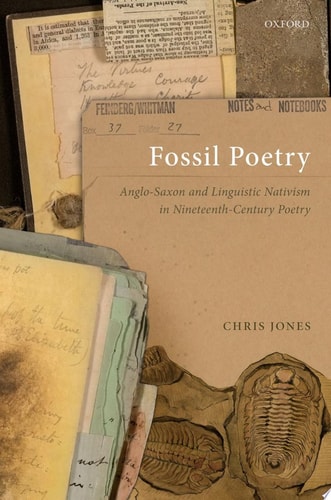
Fossil Poetry Provides The First Book-length Overview Of The Place Of Anglo-saxon In Nineteenth-century Poetry In English. It Addresses The Use And Role Of Anglo-saxon As A Resource By Romantic And Victorian Poets In Their Own Compositions, As Well As The Construction And 'invention' Of Anglo-saxon In And By Nineteenth-century Poetry. Fossil Poetry Takes Its Title From A Famous Passage On 'early' Language In The Essays Of Ralph Waldo Emerson, And Uses The Metaphor Of The Fossil To Contextualize Poetic Anglo-saxonism Within The Developments That Had Been Taking Place In The Fields Of Geology, Palaeontology, And The Evolutionary Life Sciences Since James Hutton's Apprehension Of 'deep Time' In His 1788 Theory Of The Earth. Fossil Poetry Argues That Two, Roughly Consecutive Phases Of Poetic Anglo-saxonism Took Place Over The Course Of The Nineteenth Century: Firstly, A Phase Of 'constant Roots' Whereby Anglo-saxon Is Constructed To Resemble, And So To Legitimize A Tradition Of English Romanticism Conceived As Essential And Unchanging; Secondly, A Phase In Which The Strangeness Of Many Of The 'extinct' Philological Forms Of Early English Is Acknowledged, And Becomes Concurrent With A Desire To Recover And Recuperate The Fossils Of Anglo-saxon Within Contemporary English Poetry. The Volume Advances New Readings Of Work By A Variety Of Poets Including Walter Scott, Henry Longfellow, William Wordsworth, William Barnes, Walt Whitman, Ralph Waldo Emerson, William Morris, Alfred Tennyson, And Gerard Hopkins.
Menrva's Summary
THE THESIS
This work investigates the integration of Anglo-Saxon language and philology into nineteenth-century English poetry, examining how poets utilized these archaic forms to construct national and literary identities. Chris Jones, a scholar of nineteenth-century literature, draws upon historical philological records and the intellectual history of the era to support his argument. He posits that poetic Anglo-Saxonism evolved in tandem with the burgeoning fields of geology and evolutionary science, mirroring the discovery of 'deep time' through the recovery of linguistic fossils. The text argues that this movement shifted from an initial attempt to legitimize Romantic tradition to a later fascination with the inherent strangeness of extinct linguistic forms.
THE SCOPE MAP
What You Will Find
- Analysis of the intersection between nineteenth-century philology and poetic practice.
- A framework for understanding the 'fossil' metaphor in relation to linguistic evolution.
- Detailed case studies of poets including Walter Scott, William Wordsworth, and Gerard Hopkins.
Scope Limits
- The study focuses primarily on the nineteenth century and does not extend its analysis into twentieth-century modernist linguistic experiments.
- The text does not provide a comprehensive history of the Anglo-Saxon language itself, but rather its reception and creative application by later poets.
THE AUTHORITY PERSPECTIVE
Scholars recognize this volume as a significant contribution to the study of nineteenth-century literary history and the reception of medievalism. Readers frequently note the academic density of the prose, which requires a foundational understanding of both Victorian poetry and the history of linguistics to fully appreciate the author's arguments.
Page Count:
336
Publication Date:
2018-01-01
Publisher:
Oxford University Press
ISBN-10:
0192557955
ISBN-13:
9780192557957
Poetry
Science History
Victorian
Romanticism
Literary Criticism
Philology
Community Tags
Similar Books