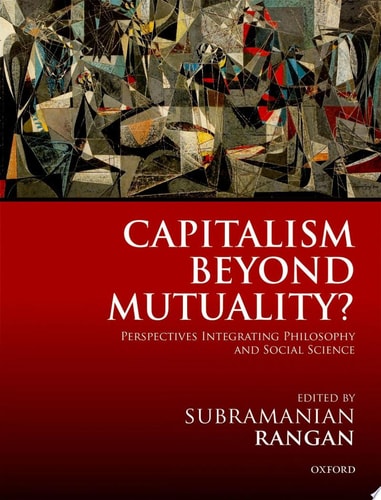
Capitalism Beyond Mutuality?
0
0
As an Amazon Associate and affiliate partner, Menrva Books earns from qualifying purchases. Learn more
Author Description
Our Quest For Prosperity Has Produced Great Output But Not Always Great Outcomes. The Growing List Of Concerns Includes Climate And Natural Capital, Abuse Of Wealth And Market Power, Economic Insecurity, Gender Bias And Disparity, Competitive And Immoderate Consumption, And Unhealthful Lifestyles. Fundamentally, When It Comes To Well-being, Fairness, And The Scope Of Our Humanity, The Modern Economic System Still Leaves Much To Be Desired. In Turn, Trust In Business And The Liberal Market System (a.k.a. Capitalism) Has Been Declining And Regulation Has Been Rising. Thankfully, A Variety Of Forces-civic, Economic, And Intellectual-have Been Probing For Better Alternatives. The Contributions In This Volume, Coauthored By Eminent Philosophers, Social Scientists, And Thoughtful Business Leaders, Are Submitted In This Spirit. Mutuality, Or The Exchange Of Benefits, Has Been Established As The Prime Principle Of Action And Inter-action In Addressing The Chronic Dilemma Of Human Interdependence. Mutuality Is A Fundament In The Social Contract Approach And It Continues To Serve Us Well. But, To Address More Robustly The Concerns Outlined Above, We Need To Conceive A Cultural Economic System That Is Anchored On More Than Mutuality. In Particular, We Must Help Evolve An Economic Paradigm Where Mutuality Is More Systematically Complemented By Reasoned And Elective Morality. Otherwise The Design Of The State As Protector And Buffer Between The Market And Society Will Remain The Central (if Inadequate) Remedy. The Essays In This Volume Integrate Philosophy And Social Science To Outline And Explore Concrete Approaches To These Important Concerns Emanating From Business Practice And Theory.
Menrva's Summary
THE THESIS
This volume investigates whether the current capitalist economic system can evolve beyond the principle of mutuality to incorporate reasoned and elective morality to address systemic societal failures. Subramanian Rangan, a professor of strategy and management, curates a collection of essays from philosophers, social scientists, and business leaders. The text argues that while mutuality serves as a foundational element of the social contract, it is insufficient to resolve modern challenges like climate change, economic inequality, and declining trust in market systems. The contributors propose a framework where economic practice is explicitly anchored in moral reasoning to reduce reliance on state regulation as the sole corrective mechanism.
THE SCOPE MAP
What You Will Find
- Analysis of the limitations of the current market system regarding well-being and fairness
- Theoretical frameworks for integrating elective morality into business strategy
- Interdisciplinary perspectives combining philosophy and social science
- Case-based explorations of business practice and systemic economic reform
Scope Limits
- The text does not provide a singular, unified policy manual for immediate legislative implementation
- It focuses primarily on the conceptual and cultural shift rather than technical macroeconomic modeling
THE AUTHORITY PERSPECTIVE
Experts identify this collection as a significant contribution to the discourse on stakeholder capitalism and corporate social responsibility. Readers frequently note the academic density of the prose, which requires a foundational understanding of economic theory and moral philosophy to fully synthesize the proposed arguments.
Page Count:
400
Publication Date:
2018-01-01
Publisher:
Oxford University Press
ISBN-10:
0192558641
ISBN-13:
9780192558640
Philosophy
Economics
Capitalism
Business Ethics
Social Science
Community Tags
Similar Books