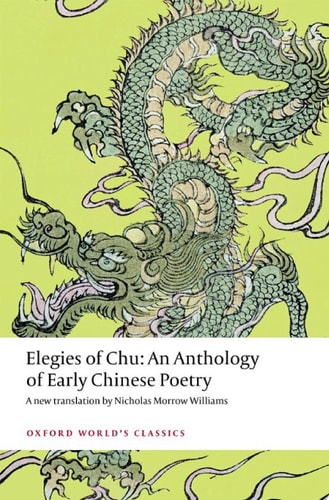
Elegies of Chu
0
0
As an Amazon Associate and affiliate partner, Menrva Books earns from qualifying purchases. Learn more
Author Description
Elegies of Chu (in Chinese, Chuci), one of the two surviving collections of ancient Chinese poetry, is a key source for the whole tradition of Chinese poetry. Because the elegies contain passionate expressions of political protest as well as shamanistic themes of magic spells and wandering spirits, they present an alternative face of early Chinese culture; one that does not align with orthodox Confucianism. This translation employs literary English devices in order to emphasise the original structure of these Chinese poems. It also examines the extraordinarily vivid diction of the source texts, including of onomatopoeia, ornate descriptions, exotic flowers, dramatic landscapes, metaphors and startling similes. This translation will be based on the original anthology compiled in the Han dynasty by Wang Yi (2nd century CE), and contains a selection of poems that were collected from the 3rd century BCE through the Han dynasty. The anthology provides readers with an understanding of Chinese literature and its evolution from free-spirited, mythico-religious songs to the more formal, polished style of the Han court.
Menrva's Summary
THE THESIS
This volume investigates the foundational role of the Chuci, or Elegies of Chu, as a primary source for the development of Chinese poetic tradition and its divergence from orthodox Confucian values. Nicholas Morrow Williams, a scholar of classical Chinese literature, utilizes the Han dynasty anthology compiled by Wang Yi to analyze the evolution of these texts. The work argues that the collection represents a distinct, mythico-religious alternative to the formal court poetry of the era, emphasizing the political and shamanistic dimensions of early Chinese culture.
THE SCOPE MAP
What You Will Find
- A selection of poems spanning the 3rd century BCE through the Han dynasty.
- Analysis of literary devices including onomatopoeia, ornate imagery, and metaphorical structures.
- A translation strategy focused on replicating the original poetic rhythm and vivid diction in English.
Scope Limits
- The text focuses primarily on the anthology as compiled by Wang Yi rather than an exhaustive philological study of every variant manuscript.
- It does not provide a comprehensive history of all Chinese literature, limiting its scope to the Chuci tradition.
THE AUTHORITY PERSPECTIVE
Scholars and students of Asian studies frequently cite this translation for its success in balancing academic rigor with accessible literary English. Experts highlight the work as a vital resource for understanding the transition from shamanistic folk traditions to the polished styles of the Han court.
Page Count:
336
Publication Date:
2022-01-01
Publisher:
OUP Oxford
ISBN-10:
0192550446
ISBN-13:
9780192550446
History
Poetry
English & College Success
English
Mythology
Literary Criticism
Classical Chinese
Community Tags
Similar Books