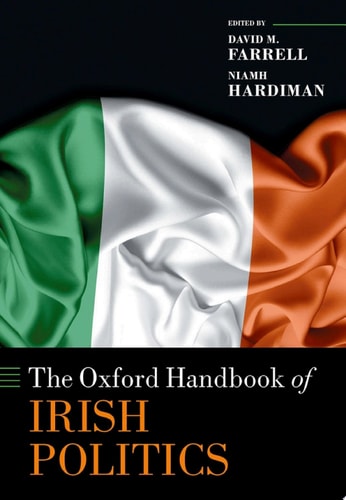
The Oxford Handbook of Irish Politics
0
0
As an Amazon Associate and affiliate partner, Menrva Books earns from qualifying purchases. Learn more
Author Description
Ireland has enjoyed continuous democratic government for almost a century, an unusual experience among countries that gained their independence in the 20th century. But the way this works in practice has changed dramatically over time. Ireland's colonial past had an enduring influence over political life for much of the time since independence, enabling stable institutions of democratic accountability, while also shaping a dismal record of economic under-development and persistent emigration. More recently, membership of the EU has brought about far-reaching transformation across almost all aspects of Irish life. But if anything, the paradoxes have only intensified. Now one of the most open economies in the world, Ireland has experienced both rapid growth and one of the most severe crashes in the wake of the Great Recession. On some measures Ireland is among the most affluent countries in the world, yet this is not the lived experience for many of its citizens. Ireland is an unequivocally modern state, yet public life continues to be marked by formative ideas and values in which tradition and modernity are held in often uneasy embrace. It is a small state that has ambitions to leverage its distinctive place in the Atlantic and European worlds to carry more weight on the world stage. Ireland continues to be deeply connected to Britain through ties of culture and trade, now matters of deep concern in the context of Brexit. And the old fault-lines between North and South, between Ireland and Britain, which had been at the core of one of Europe's longest and bloodiest civil conflicts, risk being reopened by Britain's new hard-edged approach to national and European identities. These key issues are teased out in the 41 chapters of this book, making this the most comprehensive volume on Irish politics to date.
Menrva's Summary
THE THESIS
This volume investigates the evolution and current state of Irish democratic governance, exploring the paradoxes of a nation that balances deep-seated traditions with rapid modernization. The text is compiled by Sarah Kabay and features contributions from numerous scholars who analyze the historical, economic, and social factors that have shaped the Irish state since its independence in the 20th century. The authors utilize a multi-disciplinary framework to examine how Ireland navigates its position within the European Union, its relationship with Britain, and the internal tensions between economic growth and citizen welfare.
THE SCOPE MAP
What You Will Find
- Analysis of 41 distinct chapters covering various facets of Irish political life.
- Examination of the impact of EU membership on domestic policy and economic development.
- Historical context regarding the influence of colonial legacies on modern institutions.
- Discussion on the geopolitical implications of Brexit for North-South relations.
Scope Limits
- The text focuses primarily on the political and institutional framework rather than exhaustive biographical accounts of individual politicians.
- It does not provide a predictive model for future economic fluctuations beyond current observed trends.
THE AUTHORITY PERSPECTIVE
Experts identify this volume as the most comprehensive reference work currently available for the study of Irish political systems. Readers frequently note the academic density of the prose, which makes it a standard resource for researchers and students of European governance.
Page Count:
788
Publication Date:
2021-01-01
Publisher:
OUP Oxford
ISBN-10:
0192557157
ISBN-13:
9780192557155
Irish History
International relations
Government
Civics & Citizenship
Community Tags
Similar Books