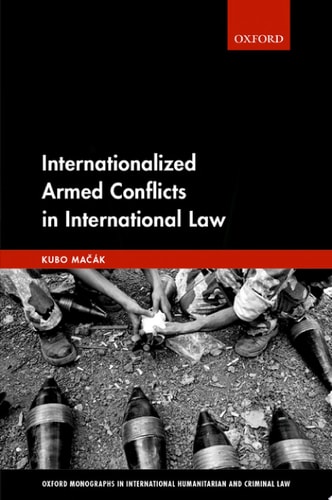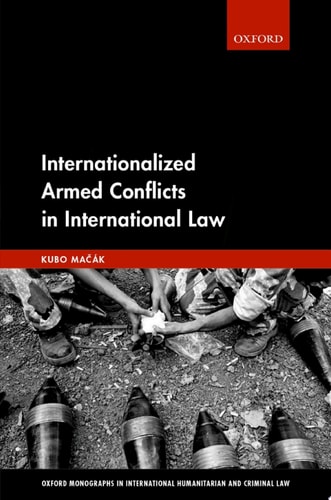
Internationalized Armed Conflicts in International Law
0
0
As an Amazon Associate and affiliate partner, Menrva Books earns from qualifying purchases. Learn more
Author Description
This book provides the first comprehensive analysis of factors that transform a prima facie non-international armed conflict (NIAC) into an international armed conflict (IAC) and the consequences that follow from this process of internationalization. It examines in detail the historical development as well as the current state of the relevant rules of international humanitarian law. The discussion is grounded in general international law, complemented with abundant references to case law, and illustrated by examples from twentieth and twenty-first century armed conflicts. In Part I, the book puts forward a thorough catalogue of modalities of conflict internationalization that includes outside intervention, State dissolution, and recognition of belligerency. It then specifically considers the legal qualification of complex situations that feature more than two conflict parties and contrasts the mechanism of internationalization of armed conflicts with the reverse process of de-internationalization. Part II of the book challenges the conventional wisdom that members of non-State armed groups do not normally benefit from combatant status. It argues that the majority of fighters belonging to non-State armed groups in most types of internationalized armed conflicts are in fact eligible for combatant status. Finally, Part III turns to belligerent occupation, traditionally understood as a leading example of a notion that cannot be transposed to armed conflicts occurring in the territory of a single State. By contrast, the book argues in favour of the applicability of the law of belligerent occupation to internationalized armed conflicts.
Menrva's Summary
THE THESIS
This book investigates the legal mechanisms and consequences that transform a non-international armed conflict into an international armed conflict. Kubo Macak, a scholar in international law, utilizes a framework grounded in general international law to analyze the historical and contemporary rules governing conflict classification. By examining state practice, case law, and complex multi-party scenarios, the author challenges established doctrines regarding combatant status and the applicability of occupation law in modern warfare.
THE SCOPE MAP
What You Will Find
- A comprehensive catalogue of conflict internationalization modalities including state dissolution and outside intervention.
- A legal analysis of combatant status for members of non-state armed groups.
- An examination of the applicability of the law of belligerent occupation to internationalized conflicts.
- Extensive references to twentieth and twenty-first century armed conflict case law.
Scope Limits
- The text focuses primarily on the legal qualification of conflicts rather than the political or sociological causes of the violence.
- It does not provide a manual for military operations but rather a theoretical and legal framework for conflict classification.
THE AUTHORITY PERSPECTIVE
Legal scholars and practitioners identify this work as a significant contribution to the study of international humanitarian law due to its rigorous re-evaluation of combatant status. Readers frequently note the academic density of the prose, which is intended for an audience of legal professionals and advanced students of international law.
Page Count:
308
Publication Date:
2018-01-01
Publisher:
OUP Oxford
ISBN-10:
0192551795
ISBN-13:
9780192551795
Military Law
International Law
Criminal Law
Professional Career & Trade