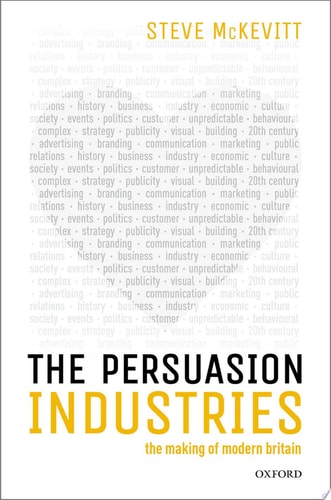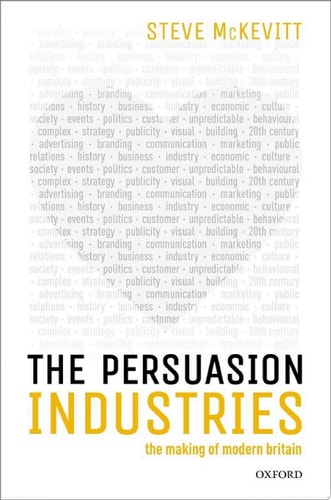
The Persuasion Industries: The Making of Modern Britain
0
0
As an Amazon Associate and affiliate partner, Menrva Books earns from qualifying purchases. Learn more
Author Description
At the end of the twentieth century, Britain was a consumer society. Commerce, intoxicating and addictive, had almost entirely colonized modern life. People were immersed in, and ultimately defined by, promotional culture. The things they consumed had overtaken class, religion, geography, or occupation as the primary form of self-identity and self-expression. For much of the twentieth century all forms of brand communication- from political campaigning to product advertising- were based on the theory of rational appeals to rational consumers. There was only one problem with this theory: it was wrong. The Persuasion Industries: The Making of Modern Britain examines develops in marketing, advertising, public relations, and branding. It explores the role they played in the emergence of the consumer society. New ideas from fields of behavioural psychology and economics, together with internal developments such as planning, positioning, and corporate branding allowed persuasion to become the driving force within many commercial enterprises. Together these changes led to the emergence of an alternative emotional model of brand communication. A simple idea that proved so compelling it changed the world we live in.
Menrva's Summary
THE THESIS
This book investigates how the evolution of marketing, advertising, and public relations fundamentally transformed British society into a consumer-driven culture. Author Steven McKevitt examines the shift from rational-based consumer theory to an emotional model of brand communication. By integrating insights from behavioral psychology and economics, he argues that promotional culture became the primary mechanism for self-identity and social expression in twentieth-century Britain.
THE SCOPE MAP
What You Will Find
- Historical analysis of the development of marketing, advertising, and public relations in Britain.
- Examination of the transition from rational consumer appeals to emotional branding strategies.
- Discussion of corporate planning, positioning, and the rise of branding as a dominant commercial force.
Scope Limits
- The analysis is primarily focused on the British context and may not fully account for global variations in consumer culture.
- The text does not provide a comprehensive history of all commercial enterprises, focusing instead on the mechanisms of persuasion.
THE AUTHORITY PERSPECTIVE
Readers and critics often note the book's accessible synthesis of complex psychological and economic theories within a historical framework. Experts frequently highlight this work as a useful resource for understanding the structural changes that defined modern British consumer identity.
Page Count:
304
Publication Date:
2018-01-01
Publisher:
OUP Oxford
ISBN-10:
0192554786
ISBN-13:
9780192554789
Business
History
Principles of Marketing
Sociology
Media Studies
Marketing
Consumer Behavior