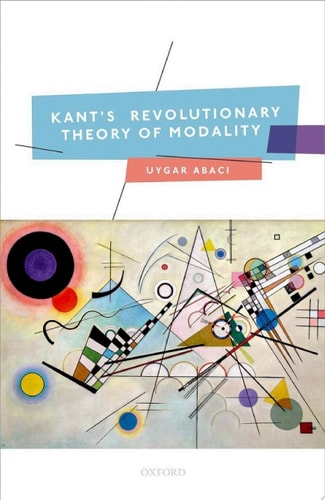
Kant's Revolutionary Theory of Modality
0
0
As an Amazon Associate and affiliate partner, Menrva Books earns from qualifying purchases. Learn more
Author Description
Kant's Revolutionary Theory of Modality is a comprehensive study of Immanuel Kant's views on modal notions of possibility, actuality or existence, and necessity. Abacı locates Kant's views on these notions in their broader historical context, establishes their continuity and transformation across Kant's precritical and critical texts, and determines their role in the substance as well as the development of Kant's philosophical project. He makes two overarching claims. First, Kant's precritical views on modality, which appear in the context of his attempts to revise the ontological argument and are critical of the tradition only from within its prevailing paradigm of modality, develop into a revolutionary theory of modality in his critical period, radicalizing his critique of the ontotheological and rationalist metaphysical tradition. While the traditional paradigm construes modal notions as fundamental ontological predicates, expressing different modes or ways of being of things, Kant's theory consists in redefining them as subjective and relational features of our discursivity, expressing different modes in which our conceptual representations of objects are related to our cognitive faculty. Second, this revolutionary theory of modality is not only a crucial component of Kant's critical epistemology and his radical critique of rationalist metaphysics, but it is in fact directly constitutive of the critical turn itself, as Kant originally formulates the latter in terms of a shift from an ontological to an epistemological approach to the question of possibility. Thus, tracing the development of Kant's understanding of modality comes to fruition in an alternative reading of Kant's overall philosophical development.
Menrva's Summary
THE THESIS
This work investigates how Immanuel Kant transformed the philosophical understanding of modality—possibility, actuality, and necessity—from an ontological predicate into a subjective, relational feature of human cognition. Author Uygar Abacı, a scholar of Kantian philosophy, utilizes a rigorous analysis of both precritical and critical texts to demonstrate that this shift in modal theory was not merely a peripheral development but a foundational element of Kant's critical turn. By tracing the evolution of these concepts, the book argues that Kant's redefinition of modality is central to his critique of rationalist metaphysics and the ontotheological tradition.
THE SCOPE MAP
What You Will Find
- A comparative analysis of Kant's precritical and critical philosophical texts.
- A detailed examination of the transition from ontological to epistemological approaches to possibility.
- A historical contextualization of Kant's work within the rationalist metaphysical tradition.
Scope Limits
- The text focuses primarily on the development of modal theory rather than a general overview of Kant's entire ethical or political philosophy.
THE AUTHORITY PERSPECTIVE
Scholars and students of Kantian studies identify this work as a specialized contribution to the understanding of Kant's metaphysical foundations. Readers frequently note the academic density of the prose, which is intended for those already familiar with the technical terminology of the Critique of Pure Reason.
Page Count:
297
Publication Date:
2019-01-01
Publisher:
OUP Oxford
ISBN-10:
0192567322
ISBN-13:
9780192567321
Philosophy
Metaphysics
Kant
Epistemology
Modality logic
Philosophy history
Community Tags
Other Editions(4)

Similar Books


Reader Comments
Share Your Thoughts
No comments yet. Be the first to share your thoughts!