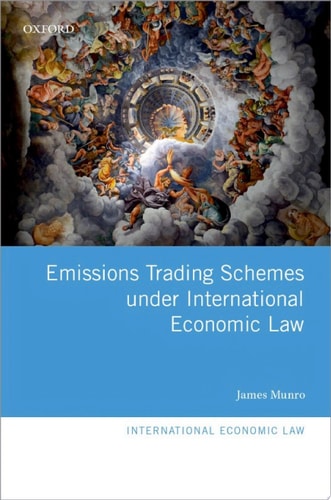
Emissions Trading Schemes under International Economic Law
0
0
As an Amazon Associate and affiliate partner, Menrva Books earns from qualifying purchases. Learn more
Author Description
The announcement by China that it will implement a national emissions trading scheme confirms the status of this instrument as the pre-eminent policy choice for mitigating climate change. China will join the dozens of existing and emerging schemes around the world - from the EU to California, South Korea to New Zealand - that use carbon units (otherwise known as emissions permits or carbon credits) to trade in greenhouse gas emissions in a multi-billion dollar global carbon market. However, to date, there has been no consensus about this pre-eminent policy instrument being regulated by international economic law through the World Trade Organization, international investment agreements, and free trade agreements. Munro addresses this issue by evaluating whether carbon units qualify as 'goods', 'services', 'financial services', and 'investments' under international economic law and showing how international economic law applies to emissions trading scheme in diverse and unexpected ways. Further, by engaging in a comparative assessment of schemes around the world, his book illustrates how and why all emissions trading schemes engage in various forms of violations of international economic law which would not, in most instances, be justified by environmental or other exceptions. In doing so, he demonstrates how such schemes can be designed or reformed in ways to ensure their future compliance.
Menrva's Summary
THE THESIS
This book investigates whether emissions trading schemes (ETS) are compatible with the existing framework of international economic law, specifically within the contexts of the World Trade Organization and various investment agreements. James Munro, a legal scholar, provides a rigorous analysis of how carbon units are classified under international trade and investment treaties. By examining the intersection of environmental policy and global trade, the author argues that current emissions trading structures frequently conflict with international legal obligations, necessitating a redesign of these mechanisms to ensure future compliance.
THE SCOPE MAP
What You Will Find
- Comparative analysis of national and regional emissions trading schemes including the EU, California, South Korea, and New Zealand.
- Legal classification of carbon units as goods, services, financial services, and investments.
- Evaluation of potential violations of international economic law and the applicability of environmental exceptions.
Scope Limits
- The text does not provide a comprehensive guide to the technical engineering or carbon accounting standards of specific schemes.
- It does not focus on domestic environmental policy outside of its relationship to international trade law.
THE AUTHORITY PERSPECTIVE
Experts identify this work as a critical contribution to the intersection of climate policy and international trade law. Readers frequently note the high level of academic density and the technical precision required to navigate the author's legal arguments.
Page Count:
224
Publication Date:
2018-01-01
Publisher:
Oxford University Press
ISBN-10:
0192563858
ISBN-13:
9780192563859
Economics
Climate Change
Law
International Law
Trade Law