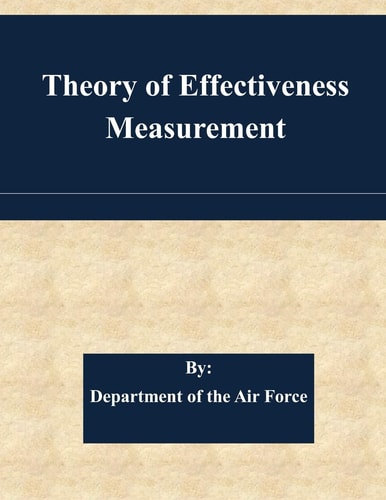
Theory of Effectiveness Measurement
0
0
As an Amazon Associate and affiliate partner, Menrva Books earns from qualifying purchases. Learn more
Author Description
Effectiveness measures provide decision makers feedback on the impact of deliberate actions and affect critical issues such as allocation of scarce resources, as well as whether to maintain or change existing strategy. Currently, however, there is no formal foundation for formulating effectiveness measures. This research presents a new framework for effectiveness measurement from both a theoretical and practical view. First, accepted effects-based principles, as well as fundamental measurement concepts are combined into a general, domain independent, effectiveness measurement methodology. This is accomplished by defining effectiveness measurement as the difference, or conceptual distance from a given system state to some reference system state (e.g. desired end-state). Then, by developing system attribute measures such that they yield a system state-space that can be characterized as a metric space, differences in system states relative to the reference state can be gauged over time, yielding a generalized, axiomatic definition of effectiveness measurement. The effectiveness measurement framework is then extended to mitigate the influence of measurement error and uncertainty by employing Kalman filtering techniques. Finally, the pragmatic nature of the approach is illustrated by measuring the effectiveness of a notional, security force response strategy in a scenario involving a terrorist attack on a United States Air Force base.
Menrva's Summary
THE THESIS
This research establishes a novel framework for effectiveness measurement, addressing the current lack of a formal foundation for such metrics. The Department of the Air Force presents a methodology that integrates effects-based principles with fundamental measurement concepts, defining effectiveness as the conceptual distance between a system's current state and a desired end-state. By developing system attribute measures that create a metric space, the framework allows for the quantification of state differences over time, leading to a generalized, axiomatic definition. The approach is further enhanced by employing Kalman filtering to mitigate measurement error and uncertainty.
THE SCOPE MAP
- A general, domain-independent methodology for effectiveness measurement.
- An axiomatic definition of effectiveness measurement derived from metric space concepts.
- Integration of Kalman filtering techniques to address measurement error and uncertainty.
- A practical illustration using a notional security force response strategy against a terrorist attack scenario.
THE AUTHORITY PERSPECTIVE
The framework presented in this research offers a theoretical and practical approach to effectiveness measurement, aiming to provide decision-makers with feedback on strategic impact and resource allocation. By defining effectiveness as a conceptual distance within a metric space, the methodology seeks to standardize how the impact of actions is gauged over time. The inclusion of Kalman filtering suggests a focus on robust and reliable measurement in the face of uncertainty. The application to a security force response strategy indicates the framework's potential utility in operational planning and evaluation.
Page Count:
182
Publication Date:
2015-03-18
Publisher:
CreateSpace Independent Publishing Platform
ISBN-10:
1508924228
ISBN-13:
9781508924227
Non-Fiction
Science & Technology
Decision Making
Military Strategy
Methodology
Community Tags
Similar Books