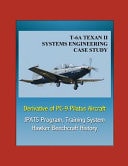
T-6A Texan II Systems Engineering Case Study: Derivative of PC-9 Pilatus Aircraft - JPATS Program, Training System, Hawker Beechcraft History
0
0
As an Amazon Associate and affiliate partner, Menrva Books earns from qualifying purchases. Learn more
Author Description
This is one of a series of systems engineering case studies prepared by the Air Force Center for Systems Engineering. This case study analyzes the T-6A Texan II, a derivative of a commercial aircraft, the PC-9, manufactured by Pilatus Aircraft, a company located in Switzerland. In addition to the United States Air Force, the primary users of the PC-9 are the Swiss Air Force, Royal Australian Air Force, Royal Saudi Air Force, Royal Thai Air Force, and Irish Air Corps. First flight of the PC-9 prototype occurred on May 7, 1984, with certification being obtained in September 1985. The Department of Defense is exponentially increasing the acquisition of joint complex systems that deliver needed capabilities demanded by our warfighter. Systems engineering is the technical and technical management process that focuses explicitly on delivering and sustaining robust, high-quality, affordable solutions. The Air Force leadership has collectively stated the need to mature a sound systems engineering process throughout the Air Force. Gaining an understanding of the past and distilling learning principles that are then shared with others through our formal education and practitioner support are critical to achieving continuous improvement. These cases support academic instruction on SE within military service academies, civilian and military graduate schools, industry continuing education programs, and those practicing SE in the field. Each of the case studies is comprised of elements of success as well as examples of SE decisions that, in hindsight, were not optimal. Chapter 1 * SYSTEMS ENGINEERING PRINCIPLES * GENERAL SYSTEMS ENGINEERING PROCESS * Introduction * Evolving Systems Engineering Process * Case Studies * Framework for Analysis * T-6A TEXAN II MAJOR LEARNING PRINCIPLES AND FRIEDMAN- SAGE MATRIX * Chapter 2 * T-6A TEXAN II DESCRIPTION * BACKGROUND * T-6A TEXAN II * JOINT PRIMARY AIRCRAFT TRAINING SYSTEM (JPATS) * HISTORY OF HAWKER BEECHCRAFT * Chapter 3 * T-6A TEXAN I
Menrva's Summary
THE THESIS
This case study analyzes the T-6A Texan II aircraft program through the lens of systems engineering principles. The book examines the T-6A Texan II, a derivative of the Pilatus PC-9, detailing its development within the Joint Primary Aircraft Training System (JPATS) program and the history of Hawker Beechcraft. It aims to provide learning principles derived from both successful and suboptimal systems engineering decisions made during the program, supporting academic and professional development in the field.
THE SCOPE MAP
- Analysis of the T-6A Texan II, a derivative of the Pilatus PC-9.
- Examination of the Joint Primary Aircraft Training System (JPATS) program.
- Historical overview of Hawker Beechcraft.
- Principles of Systems Engineering (SE) applied to the program.
- Framework for analyzing SE decisions.
- Identification of both successful and suboptimal SE decisions.
- Learning principles distilled from the case study.
THE AUTHORITY PERSPECTIVE
This technical case study is presented as part of a series by the Air Force Center for Systems Engineering, intended for academic and professional development in military and civilian aviation engineering contexts. The material focuses on dissecting the T-6A Texan II program to extract actionable learning principles for systems engineering practitioners. Its structure suggests a detailed examination of program history, technical specifications, and decision-making processes, aiming to inform future aerospace development.
Page Count:
90
Publication Date:
2017-05-13
Publisher:
Amazon Digital Services LLC - KDP Print US
ISBN-10:
1521289255
ISBN-13:
9781521289259
Non-Fiction
Science & Technology
Aerospace
Military History
Engineering
Case Study
Aviation
Community Tags
Similar Books









Reader Comments
Share Your Thoughts
No comments yet. Be the first to share your thoughts!