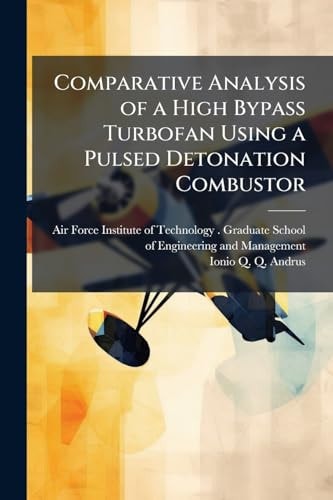
Comparative Analysis of a High Bypass Turbofan Using a Pulsed Detonation Combustor
0
0
As an Amazon Associate and affiliate partner, Menrva Books earns from qualifying purchases. Learn more
Author Description
It has been proposed that the implementation of a pulsed detonation combustor in a high-bypass turbofan engine would result in an engine that is both more efficient and more reliable. The validity of the performance claims are evaluated based on a comparison between the baseline and hybrid turbofans as modeled in the Numerical Propulsion System Simulation (NPSS). The engine cycle of the baseline high-bypass turbofan is evaluated and compared using both the Aircraft Engine Design System (AEDsys) and NPSS programs. The baseline engine agreed to within 1% on the net thrust calculation and specific fuel consumption between the two programs. Differences are traceable to the variation in specific heat models and to different methods of calculating temperature across the turbine and compressor components. The hybrid pulsed detonation engine model shares a common architecture with the baseline turbofan model. Inlet mass flow and core mass flow are maintained, but the combustor of the baseline engine is replaced with a pulsed detonation combustor for the hybrid engine. The effect of detonation on the core airflow is calculated using a closed form solution of the Chapman-Jouguet Mach number with a total energy correction applied. Cycle time is calculated to provide a reasonable estimate of frequency for the user input geometry. Effects of sub-component design choices within the pulsed detonation combustor are evaluated using simple parametric studies. These studies are used to select an optimal architecture for the combustor. The effects of detonation are accounted for by applying pressure and temperature losses to the fluid exiting the combustor. A parametric study was performed to demonstrate what level of loss continues to yield a more efficient engine. Results show improvement in thrust specific fuel consumption with careful selection of combustor design parameters. There is a definite level of acceptable loss that if surpassed makes pulsed detonation combustion a
Menrva's Summary
THE THESIS
This analysis evaluates the potential efficiency and reliability gains of integrating a pulsed detonation combustor (PDC) into a high-bypass turbofan engine. The study compares a baseline turbofan model with a hybrid model incorporating a PDC, using the Numerical Propulsion System Simulation (NPSS) and Aircraft Engine Design System (AEDsys) for validation. The research details the engine cycle evaluation, the methodology for calculating detonation effects on airflow, and parametric studies to optimize the PDC architecture. The findings demonstrate that careful selection of combustor design parameters can lead to improved thrust-specific fuel consumption, provided that pressure and temperature losses do not exceed an acceptable threshold.
THE SCOPE MAP
- Validation of baseline high-bypass turbofan engine performance using AEDsys and NPSS.
- Comparison of net thrust and specific fuel consumption between two simulation programs.
- Modeling of a hybrid turbofan engine with a pulsed detonation combustor replacing the baseline combustor.
- Calculation of detonation effects on core airflow using a closed-form solution of the Chapman-Jouguet Mach number.
- Estimation of pulsed detonation combustor frequency based on cycle time.
- Parametric studies to determine optimal sub-component design choices for the PDC.
- Analysis of pressure and temperature losses associated with detonation.
- Demonstration of improved thrust specific fuel consumption with optimized PDC parameters.
THE AUTHORITY PERSPECTIVE
The research presented here offers a detailed technical comparison of turbofan engine designs, focusing on the integration of pulsed detonation combustors. The methodology involves rigorous simulation and parametric studies to assess performance claims. The findings suggest that while PDC integration can yield efficiency improvements, careful management of associated losses is critical for realizing these benefits. This work provides valuable data for engineers and researchers in aerospace propulsion.
Page Count:
144
Publication Date:
2025-05-22
Publisher:
Creative Media Partners, LLC
ISBN-10:
1025085256
ISBN-13:
9781025085258
Non-Fiction
Science & Technology
Propulsion systems
Thermodynamics
Aerospace Engineering
Combustion
Community Tags
Similar Books





Reader Comments
Share Your Thoughts
No comments yet. Be the first to share your thoughts!