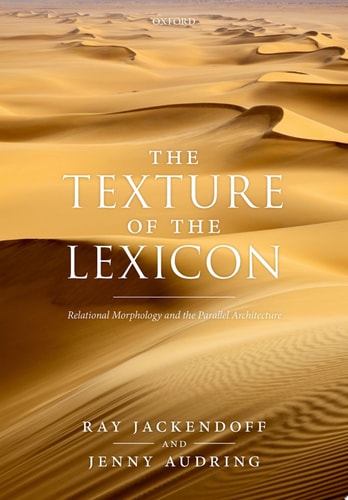
The Texture of the Lexicon: Relational Morphology and the Parallel Architecture
0
0
As an Amazon Associate and affiliate partner, Menrva Books earns from qualifying purchases. Learn more
Author Description
In this volume, Ray Jackendoff and Jenny Audring embark on a major reconceptualization of linguistic theory as seen through the lens of morphology. Their approach, Relational Morphology, extends the Parallel Architecture developed by Jackendoff in Foundations of Language (2002), Simpler Syntax (2005), and Meaning and the Lexicon (2010). The framework integrates morphology into the overall architecture of language, enabling it to interact insightfully with phonology, syntax, semantics, and above all, the lexicon. The first part of the book situates morphology in the language faculty, and introduces a novel formalism that unifies the treatment of all morphological patterns, inflectional or derivational, systematic or marginal. Central to the theory is the lexicon, which both incorporates the rules of grammar and explicitly encodes relationships among words and among grammatical patterns. Part II puts the theory to the test, applying it to a wide range of familiar and less familiar morphological phenomena. Part III connects Relational Morphology with issues of language processing and language acquisition, and shows how its formal tools can be extended to a variety of linguistic and nonlinguistic phenomena outside morphology. The value of Relational Morphology thus lies not only in the fact that it can account for a range of morphological phenomena, but also in how it integrates linguistic theory, psycholinguistics, and human cognition.
Menrva's Summary
THE THESIS
This book investigates how morphology can be integrated into a unified linguistic framework that accounts for the interaction between phonology, syntax, semantics, and the lexicon. Ray Jackendoff and Jenny Audring, both established scholars in cognitive linguistics, propose 'Relational Morphology' as an extension of the Parallel Architecture. Their argument posits that the lexicon is not merely a list of words, but a dynamic structure that encodes grammatical rules and relationships, thereby bridging the gap between linguistic theory and human cognition.
THE SCOPE MAP
What You Will Find
- A formal model for unifying inflectional and derivational morphological patterns
- Applications of Relational Morphology to diverse linguistic phenomena
- Theoretical connections between morphology, language processing, and acquisition
Scope Limits
- The text focuses primarily on the Parallel Architecture framework rather than competing generative or minimalist models
- It does not provide an exhaustive survey of all non-Western language morphological systems
THE AUTHORITY PERSPECTIVE
Linguists and cognitive scientists recognize this work as a significant development in the evolution of the Parallel Architecture. Readers frequently note the high level of technical density, making it a text primarily suited for advanced students and professional researchers in the field of theoretical linguistics.
Page Count:
336
Publication Date:
2019-01-01
Publisher:
OUP Oxford
ISBN-10:
0192562924
ISBN-13:
9780192562920
Linguistics
English & College Success
Morphology
Semantics
Syntax
English
Psycholinguistics
Community Tags
Similar Books