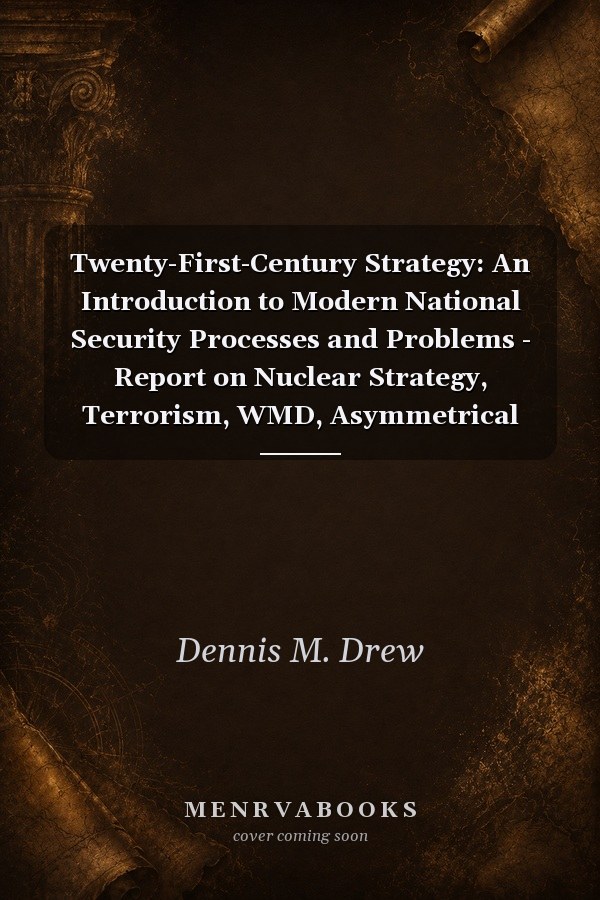
Twenty-First-Century Strategy: An Introduction to Modern National Security Processes and Problems - Report on Nuclear Strategy, Terrorism, WMD, Asymmetrical Warfare, and Insurgency Warfare
0
0
As an Amazon Associate and affiliate partner, Menrva Books earns from qualifying purchases. Learn more
Author Description
This new work defines national security strategy, its objectives, the problems it confronts, and the influences that constrain and facilitate its development and implementation in a post-Cold War, post-9/11 environment. The authors note that making and implementing national strategy centers on risk management and present a model for assessing strategic risks and the process for allocating limited resources to reduce them. The major threats facing the United States now come from its unique status as "the sole remaining superpower" against which no nation-state or other entity can hope to compete through conventional means. The alternative is what is now called asymmetrical or fourth generation warfare. Drew and Snow discuss all these factors in detail and bring them together by examining the continuing problems of making strategy in a changed and changing world.Contents * Foreword * Introduction * Notes * Section I * Framing the Problem * 1 Strategy In Perspective * Warfare in the Eighteenth Century * Foundations of Modern Warfare * Contrasts in the Cold War * Conclusions * 2 The Strategy Process - An Overview * Determining National Security Objectives * Formulating Grand National Strategy * Developing Military Strategy * Composing Operational Strategy * Formulating Battlefield Strategy (Tactics) * Influences on the Strategy Process * Conclusions * Section II * The Political Dimension * 3 Grand National Strategy * Vital National Interests * Instruments of National Power * Conclusions * Notes * 4 The Political Environment of Grand Strategy * Influences on Grand Strategy * Strategic Culture * Summary and Conclusions * Notes * 5 Grand Strategy Actors and Institutions * Executive Branch * Legislative Branch * Other Actors * Conclusions * Notes * Section III * The Military Dimension * 6 Military Strategy * Force Employment Strategy * Force Development Strategy * Force Deployment Strategy * Coordination of Military Strategy * Conclusions * Note * 7 Operational Strategy * O
Menrva's Summary
THE THESIS
This work defines national security strategy, its objectives, the problems it confronts, and the influences that constrain and facilitate its development and implementation in a post-Cold War, post-9/11 environment. The authors, affiliated with Air University Press and the U.S. Air Force, present a model for assessing strategic risks and allocating resources, noting that national strategy centers on risk management. They address the unique threats facing the United States as the sole superpower, leading to asymmetrical or fourth-generation warfare, and examine the continuing challenges of strategy formulation in a dynamic world.
THE SCOPE MAP
- Definitions of national security strategy and its objectives.
- Analysis of post-Cold War and post-9/11 strategic challenges.
- A model for assessing strategic risks and resource allocation.
- Discussion of asymmetrical warfare and fourth-generation warfare.
- Examination of the influences on the strategy process.
- Detailed breakdown of strategy formulation from grand national strategy to battlefield tactics.
- Analysis of the political and military dimensions of strategy.
THE AUTHORITY PERSPECTIVE
This book provides a comprehensive overview of modern national security processes and problems, focusing on the strategic challenges faced by the United States in the contemporary global landscape. It delves into critical areas such as nuclear strategy, terrorism, WMD, and asymmetrical warfare, offering a structured approach to understanding and managing these complex issues. The authors' model for risk assessment and resource allocation is presented as a key framework for policymakers. The work is structured to guide readers through the historical context, the strategic process, and the political and military dimensions of national security.
Page Count:
168
Publication Date:
2017-09-18
Publisher:
Independently Published
ISBN-10:
1549771892
ISBN-13:
9781549771897
History
Non-Fiction
Politics
National security
Terrorism
Military Strategy
Community Tags
Similar Books










Reader Comments
Share Your Thoughts
No comments yet. Be the first to share your thoughts!