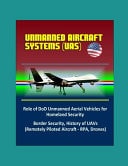
Unmanned Aircraft Systems (UAS): Role of DoD Unmanned Aerial Vehicles for Homeland Security - Border Security, History of UAVs (Remotely Piloted Aircraft - RPA, Drones)
0
0
As an Amazon Associate and affiliate partner, Menrva Books earns from qualifying purchases. Learn more
Author Description
This paper seeks to identify roles in which the nation can leverage these assets in the defense of the homeland. Drug interdiction, port security, disaster relief, search and rescue, and border patrol are just a few potential roles. Finally, this paper looks at potential obstacles, both legal and policy, to implementing a proposed way-ahead. How can the United States leverage DoD ISR assets to secure and defend the homeland? The U.S. border with Canada stretches over 5,400 miles. To the south, the border with Mexico is in excess of 1,950 miles. Additionally, the U.S. has over 12,380 miles of coastline to defend.(2) These expansive borders and vast amounts of coastline present a large challenge to those agencies responsible for U.S. security. The difficulty with securing our southern border, in particular, is well documented. The U.S.-Mexico border has 43 legitimate crossing points. However the rest of the border consists of open desert terrain, rugged mountains and other geographic obstacles making surveillance. Inability of U.S. security forces to monitor the whole border all of the time makes it easier to smuggle drugs and illegal aliens into the United States. (3) Not only are drugs a menace to the U.S., a larger concern would be if terrorist organizations such as Al Qaeda choose to smuggle in their operatives and/or weapons of mass destruction (WMD) via the same routes used for drug trafficking. Today, numerous federal and state organizations are charged with maintaining the security and defense of the homeland: Northern Command (NORTHCOM), Immigration and Customs Enforcement (ICE), Customs and Border Patrol (CBP), Drug Enforcement Agency (DEA), Federal Bureau of Investigations (FBI), Border Patrol, Coast Guard, state and local police departments. Many of these organizations operate under strained budgets and may lack sufficient funding and personnel to acquire and maintain all of the surveillance capabilities they seek. It is imperative to leverage existing cap
Menrva's Summary
THE THESIS
This paper investigates the potential roles of Department of Defense Unmanned Aerial Vehicles (UAVs) in enhancing homeland security, particularly concerning border security. The document examines the challenges posed by expansive U.S. borders and coastlines, highlighting the difficulties in monitoring these areas for threats such as drug smuggling, illegal immigration, and potential terrorist activities. It addresses the budgetary and personnel constraints faced by various federal and state security agencies and proposes leveraging existing Department of Defense Intelligence, Surveillance, and Reconnaissance (ISR) assets as a solution.
THE SCOPE MAP
- Historical overview of Unmanned Aerial Vehicles (UAVs), also known as Remotely Piloted Aircraft (RPA) and drones.
- Analysis of specific homeland security roles for DoD UAVs, including drug interdiction, port security, disaster relief, search and rescue, and border patrol.
- Examination of the challenges in securing the U.S. borders with Canada and Mexico, and its extensive coastline.
- Discussion of the threats posed by smuggling of drugs, illegal aliens, and weapons of mass destruction.
- Identification of various federal and state agencies involved in homeland security and their operational constraints.
- Exploration of potential legal and policy obstacles to implementing UAV integration.
- A proposed way-ahead for leveraging DoD ISR assets for homeland defense.
THE AUTHORITY PERSPECTIVE
This paper, authored by entities within the Department of Defense and the U.S. Army War College, presents a strategic analysis of Unmanned Aircraft Systems (UAS) for homeland security. The work focuses on the practical application of existing DoD assets to address critical security challenges, particularly along U.S. borders. It aims to identify operational roles and acknowledge the policy and legal frameworks that would govern such deployments. The analysis is grounded in the operational realities and resource limitations faced by security agencies.
Page Count:
58
Publication Date:
2017-08-20
Publisher:
Amazon Digital Services LLC - KDP Print US
ISBN-10:
1549549510
ISBN-13:
9781549549519
Politics
History
Non-Fiction
Border security
Homeland Security
Military Technology
Community Tags
Similar Books








Reader Comments
Share Your Thoughts
No comments yet. Be the first to share your thoughts!