Disaffected Parties
0
0
As an Amazon Associate and affiliate partner, Menrva Books earns from qualifying purchases. Learn more
Author Description
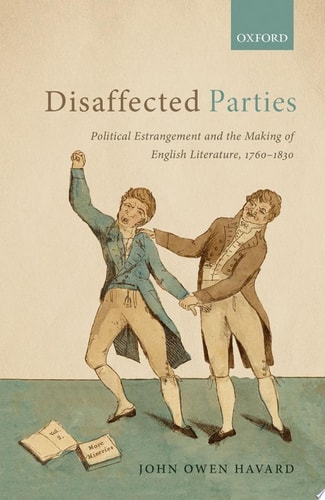
Disaffected Parties reveals how alienation from politics effected crucial changes to the shape and status of literary form. Recovering the earliest expressions of grumbling, irritability, and cynicism towards politics, this study asks how unsettled partisan legacies converged with more recent discontents to forge a seminal period in the making of English literature, and thereby poses wide-ranging questions about the lines between politics and aesthetics. Reading works including Laurence Sterne's Tristram Shandy, James Boswell's Life of Johnson, the novels of Maria Edgeworth and Jane Austen, and the satirical poetry of Lord Byron in tandem with print culture and partisan activity, this book shows how these writings remained animated by disaffected impulses and recalcitrant energies at odds with available party positions and emerging governmental norms—even as they sought to imagine perspectives that looked beyond the divided political world altogether. 'No one can be more sick of-or indifferent to politics than I am' Lord Byron wrote in 1820. Between the later eighteenth century and the Romantic age, disaffected political attitudes acquired increasingly familiar shapes. Yet this was also a period of ferment in which unrest associated with the global Age of Revolutions (including a dynamic transatlantic opposition movement) collided with often inchoate assemblages of parties and constituencies. As writers adopted increasingly emphatic removes from the political arena and cultivated familiar stances of cynicism, detachment, and retreat, their estrangement also promised to loop back into political engagement-and to make their works 'parties' all their own.
Menrva's Summary
THE THESIS
This study investigates how political alienation and cynicism among writers between the late eighteenth century and the Romantic age fundamentally altered the development of English literary forms. John Owen Havard, a scholar of eighteenth-century literature, examines how authors navigated the tension between partisan political identities and a growing desire for aesthetic independence. By analyzing the intersection of print culture and political unrest, the author argues that expressions of detachment were not merely passive, but served as a mechanism for creating new, autonomous literary spaces.
THE SCOPE MAP
What You Will Find
- Analysis of major works by Laurence Sterne, James Boswell, Maria Edgeworth, Jane Austen, and Lord Byron
- Examination of the relationship between the global Age of Revolutions and domestic partisan politics
- Exploration of how cynicism and irritability influenced narrative structure and aesthetic distance
Scope Limits
- The study focuses primarily on the British literary tradition and does not provide a comprehensive global history of political theory
- It does not attempt to provide a biography of the authors mentioned, but rather focuses on their engagement with political discourse
THE AUTHORITY PERSPECTIVE
Scholars in the field of Romanticism and eighteenth-century studies recognize this work as a rigorous examination of the intersection between political history and aesthetic form. Readers frequently note the academic density of the prose, which provides a nuanced look at how historical disaffection shaped the canon of English literature.
Page Count:
272
Publication Date:
2019-01-01
Publisher:
Oxford University Press
ISBN-10:
0192569538
ISBN-13:
9780192569530
English literature
Political History
Literary Criticism
Romanticism
Eighteenth Century
Community Tags
Similar Books