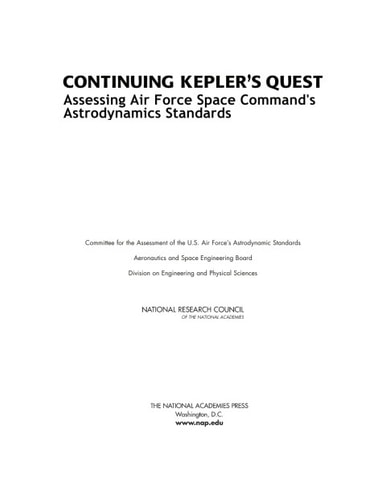
Continuing Kepler's Quest
0
0
As an Amazon Associate and affiliate partner, Menrva Books earns from qualifying purchases. Learn more
Author Description
In February 2009, the commercial communications satellite Iridium 33 collided with the Russian military communications satellite Cosmos 2251. The collision, which was not the first recorded between two satellites in orbit—but the most recent and alarming—produced thousands of pieces of debris, only a small percentage of which could be tracked by sensors located around the world. In early 2007, China tested a kinetic anti-satellite weapon against one of its own satellites, which also generated substantial amounts of space debris. These collisions highlighted the importance of maintaining accurate knowledge, and the associated uncertainty, of the orbit of each object in space. These data are needed to predict close approaches of space objects and to compute the probability of collision so that owners/operators can decide whether or not to make a collision avoidance maneuver by a spacecraft with such capability. The space object catalog currently contains more than 20,000 objects, and when the planned space fence radar becomes operational this number is expected to exceed 100,000. A key task is to determine if objects might come closer to each other, an event known as "conjunction," and the probability that they might collide. The U.S. Air Force is the primary U.S. government organization tasked with maintaining the space object catalog and data on all space objects. This is a complicated task, involving collecting data from a multitude of different sensors-many of which were not specifically designed to track orbiting objects-and fusing the tracking data along with other data, such as data from atmospheric models, to provide predictions of where objects will be in the future. The Committee for the Assessment of the U.S. Air Force's Astrodynamic Standards collected data and heard from numerous people involved in developing and maintaining the current astrodynamics standards for the Air Force Space Command (AFSPC), as well as representatives of the user community,
Menrva's Summary
THE THESIS
The U.S. Air Force faces a growing challenge in accurately tracking and predicting the orbits of space objects to prevent catastrophic collisions. The increasing number of satellites and debris in orbit, highlighted by recent alarming collisions, necessitates precise astrodynamic standards. This report examines the complexities of collecting and fusing data from diverse sensors and models to maintain the space object catalog and compute collision probabilities. It addresses the critical need for accurate orbital knowledge to enable collision avoidance maneuvers and ensure the safety of space operations.
THE SCOPE MAP
- Analysis of recent satellite collisions and their impact on space debris generation.
- Examination of the U.S. Air Force's role in maintaining the space object catalog.
- Discussion of the challenges in fusing data from multiple, varied sensor systems.
- Assessment of current astrodynamic standards and their associated uncertainties.
- Exploration of the need for improved orbital prediction and collision probability computation.
- Insights from individuals involved in developing and maintaining astrodynamics standards.
- Perspectives from the user community regarding space object tracking data.
THE AUTHORITY PERSPECTIVE
This report is a technical assessment by the National Research Council, commissioned to evaluate the astrodynamic standards used by the U.S. Air Force. It focuses on the technical challenges and data requirements for tracking space objects and mitigating collision risks. The work synthesizes information from experts and users within the field, aiming to inform future improvements in space situational awareness and orbital management.
Page Count:
82
Publication Date:
2012-09-06
Publisher:
National Academies Press
ISBN-10:
0309261430
ISBN-13:
9780309261432
Non-Fiction
Science
Space Policy
Astrodynamics
Community Tags
Similar Books










Reader Comments
Share Your Thoughts
No comments yet. Be the first to share your thoughts!