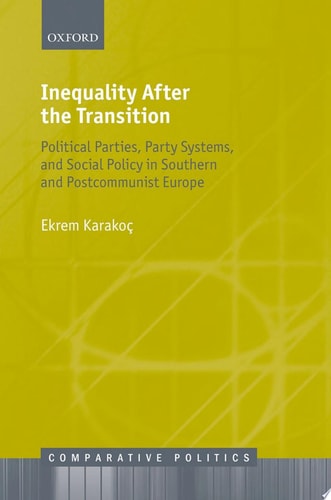
Inequality After The Transition
0
0
As an Amazon Associate and affiliate partner, Menrva Books earns from qualifying purchases. Learn more
Author Description
After The Transition Is An All-encompassing Examination Of The Origins, Increase, And Persistence Of Inequality In New Democracies. It Challenges The Conventional Thinking Found In Much Of The Democratization-inequality Literature, And Offers A New Theory. It Speaks Simultaneously To Literature Of Democratization, Party Systems, Social Policy, And Inequality To Explain Why Democracies Are Not Able To Fulfill Their Promise To The Disadvantaged And Why They Cannot Achieve Income Equality. It Investigates Social Policy Programs Such As Pensions, Unemployment Benefits, And Other Social Transfers In Poland And The Czech Republic In Post-communist Europe, And Turkey And Spain In Southern Europe. The Volume Traces The Origins And Development Of Social Policy, From The Formation Of Nation-states To The Present, And Considers How Different Political Regimes, Whether Totalitarian; Post-totalitarian; Or Authoritarian, Designed Welfare Policies To Prioritize Civil Servants And The Working Classes In Formal Sectors At The Expense Of The Majority Poor. It Then Demonstrates How These Legacies Perpetuate And Widen Disparities In Access To Welfare Policies, And Thus Income Inequality In Countries Where Low Mobilization By The Poor And Unstable Party Systems Prevail. This Study Employs Interviews With Polish, Czech, Turkish, And Spanish Union Leaders; Bureaucrats; And Business People While Also Conducting An Original Survey In Turkey To Dissect The Linkage Between Organized Groups And Parties. Employing A Multi-method Approach, Two Paired Case Studies On These Countries Also Demystify Why And How New Populist Parties Have Successfully Appealed To Voters And Affected The Trajectory Of Social Policy, Party Systems And Inequality. Comparative Politics Is A Series For Researchers, Teachers, And Students Of Political Science That Deals With Contemporary Government And Politics. Global In Scope, Books In The Series Are Characterised By A Stress On Comparative Analysis And Strong Methodolog
Menrva's Summary
THE THESIS
This book investigates why new democracies frequently fail to fulfill their promise of reducing income inequality and improving conditions for the disadvantaged. Author Ekrem Karakoç, a political scientist, utilizes a multi-method approach to analyze the historical legacies of welfare policies in post-communist and Southern European nations. He argues that institutional path dependency and the influence of organized interest groups within unstable party systems prevent these regimes from achieving equitable income distribution.
THE SCOPE MAP
What You Will Find
- Comparative analysis of social policy development in Poland, the Czech Republic, Turkey, and Spain.
- Examination of welfare programs including pensions and unemployment benefits.
- Qualitative data from interviews with union leaders, bureaucrats, and business representatives.
- Quantitative analysis derived from original survey data regarding party-group linkages.
Scope Limits
- The study focuses primarily on four specific nations and does not provide a global survey of all emerging democracies.
- The analysis is restricted to the impact of formal sector welfare policies rather than informal economic sectors.
THE AUTHORITY PERSPECTIVE
Experts in comparative politics identify this work as a rigorous contribution to the study of democratization and social welfare. Readers frequently note the academic density of the prose and the effectiveness of the paired case study methodology in explaining complex political outcomes.
Page Count:
392
Publication Date:
2018-01-01
Publisher:
Oxford University Press
ISBN-10:
0192561650
ISBN-13:
9780192561657
Economics
Sociology
Comparative Politics
Social policy
Community Tags
Similar Books