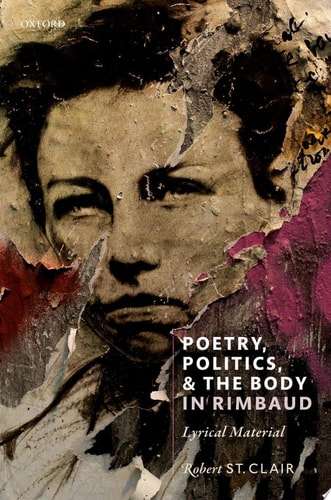
Poetry, Politics, and the Body in Rimbaud
0
0
As an Amazon Associate and affiliate partner, Menrva Books earns from qualifying purchases. Learn more
Author Description
Bodies abound in Rimbaud's poetry in a way that is nearly unprecedented in the nineteenth-century poetic canon: lazy, creative, rule-breaking bodies, queer bodies, marginalized and impoverished bodies, revolting and revolutionary, historical bodies. The question that Poetry, Politics, and the Body seeks to answer is: What does this corporeal density mean for reading Rimbaud? What kind of sense are we to make of this omnipresence of the body in the Rimbaldian corpus, from first to last–from the earliest poems in verse celebrating the sheer, simple delight of running away from wherever one is and stretching one's legs out under a table, to the ultimate flight away from poetry itself? In response, this book argues that the body appears–often literally–as a kind of gap, breach, or aperture through which Rimbaud's poems enter into contact with history and a larger body of other texts. Simply put, the body is privileged 'lyrical material' for Rimbaud: a figure for human beings in their exposed, finite creatureliness and in their unpredictable agency and interconnectedness. Its presence in the early work allows us not only to contemplate what a strange, sensuous thing it is to be embodied, to be both singular and part of a collective, it also allows the poet to diagnose, and the reader to perceive, a set of seemingly intractable, 'real' socio-economic, political, and symbolic problems. Rimbaud's bodies are, in other words, utopian bodies: sites where the historical and the lyrical, the ideal and the material, do not so much cancel each other out as become caught up in one another.
Menrva's Summary
THE THESIS
This work investigates the significance of corporeal imagery in Arthur Rimbaud's poetry to determine how the physical body functions as a bridge between lyrical expression and historical reality. Robert St. Clair examines the Rimbaldian corpus to argue that the body serves as a critical aperture, allowing the poet to engage with socio-economic and political structures. By analyzing the transition from early verse to the poet's eventual departure from literature, the author posits that the body acts as a site of utopian potential where the material and the ideal intersect.
THE SCOPE MAP
What You Will Find
- Analysis of the evolution of bodily representation across Rimbaud's entire poetic career
- Examination of the body as a figure for human agency and finite creatureliness
- Theoretical framework connecting lyrical material to historical and political contexts
Scope Limits
- The text does not provide a comprehensive biography of Rimbaud's personal life
- The study does not cover the influence of Rimbaud on later surrealist movements in detail
THE AUTHORITY PERSPECTIVE
Scholars and students of nineteenth-century French literature frequently cite this work for its rigorous focus on the intersection of materiality and political theory. Readers often note the academic density of the prose, which is intended for those already familiar with the Rimbaldian corpus.
Page Count:
352
Publication Date:
2018-01-01
Publisher:
Oxford University Press
ISBN-10:
0192561219
ISBN-13:
9780192561213
Philosophy
Literary Criticism
French literature
Political Theory
Community Tags
Similar Books