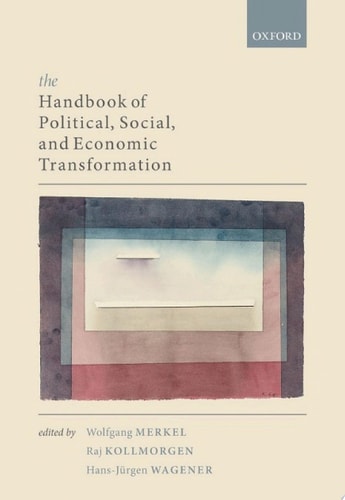
The Handbook of Political, Social, and Economic Transformation
0
0
As an Amazon Associate and affiliate partner, Menrva Books earns from qualifying purchases. Learn more
Author Description
Political, social, and economic transformation is a complex historical phenomenon. It can adequately be analysed only by a multidisciplinary approach. The Handbook brings together an international team of scholars who are specialists in their respective research fields. It introduces the most important areas, theories, and methods in transformation research, with particular attention placed on the historical and comparative dimension. Although focussing on post-communist and other democratic transformations in our epoch, the Handbook therefore presents and discusses not only their problems, paths, and developments, but also deals with the antecedent 'waves', beginning with the Meiji Restoration in Japan in 1868 and its aftermath. The book is structured into six parts. Starting with basic concepts as systems, actors, and institutions (Section I), it gives an overview over major theoretical approaches and research methods (Sections II and III). The connection of theory and method with their application is essential, allowing special insights into the past and opens analytical avenues for transformation research in the future. Section (IV) provides a historically oriented description or interpretation of particular 'waves' or types of societal transformation. With a clear focus on present transformations, the contributions to Section V provide a description and discussion of the problems, structures, actors, and courses of the transformations within different spheres of (civil) society, politics, law, and economics. Finally, brief lexicographic entries in Section VI delineate research perspectives and facts about relevant issues of societal transformation. Each of the 79 contributions contains a concise list of the most important research literature.
Menrva's Summary
THE THESIS
This volume investigates the multifaceted nature of political, social, and economic transformation by synthesizing multidisciplinary research into a unified analytical framework. The authors, a team of international scholars led by Wagener, Kollmorgen, and Merkel, utilize historical and comparative data to examine how societies transition through systemic change. By bridging theoretical concepts with empirical application, the text provides a comprehensive methodology for understanding both past historical waves and contemporary democratic shifts.
THE SCOPE MAP
What You Will Find
- Theoretical frameworks concerning systems, actors, and institutions
- Comparative analysis of historical transformation waves starting from the 1868 Meiji Restoration
- Methodological approaches for researching societal change
- Lexicographic entries detailing specific issues and research perspectives
Scope Limits
- The text focuses primarily on post-communist and democratic transitions rather than exhaustive global coverage of all societal shifts
- It does not provide a singular predictive model for future transformations, focusing instead on analytical avenues
THE AUTHORITY PERSPECTIVE
Experts identify this handbook as a foundational reference for students and researchers navigating the complexities of transition studies. Readers frequently note the academic density of the prose, which serves as a rigorous resource for those seeking a structured overview of the field.
Page Count:
714
Publication Date:
2019-01-01
Publisher:
OUP Oxford
ISBN-10:
0192565478
ISBN-13:
9780192565471
Economics
History
Social change
Comparative Politics
Reference
Sociology
Community Tags
Similar Books