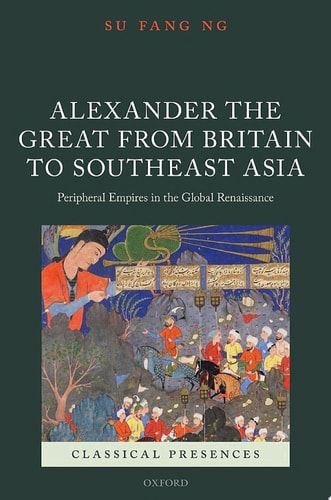
Alexander the Great from Britain to Southeast Asia: Peripheral Empires in the Global Renaissance
0
0
As an Amazon Associate and affiliate partner, Menrva Books earns from qualifying purchases. Learn more
Author Description
No figure has had a more global impact than Alexander the Great, whose legends have encircled the globe and been translated into a dizzying multitude of languages, from Indo-European and Semitic to Turkic and Austronesian. Alexander the Great from Britain to Southeast Asia examines parallel traditions of the Alexander Romance in Britain and Southeast Asia, demonstrating how rival Alexanders - one Christian, the other Islamic - became central figures in their respective literatures. In the early modern age of exploration, both Britain and Southeast Asia turned to literary imitations of Alexander to imagine their own empires and international relations, defining themselves as peripheries against the Ottoman Empire's imperial center: this shared classical inheritance became part of an intensifying cross-cultural engagement in the encounter between the two, allowing a revealing examination of their cultural convergences and imperial rivalries and a remapping of the global literary networks of the early modern world. Rather than absolute alterity or strangeness, the narrative of these parallel traditions is one of contact - familiarity and proximity, unexpected affinity and intimate strangers.
Menrva's Summary
THE THESIS
How did the figure of Alexander the Great function as a foundational literary tool for early modern empires in both Britain and Southeast Asia? Su Fang Ng, a scholar specializing in early modern literature and global cultural exchange, utilizes a comparative framework to analyze the Alexander Romance. She argues that these disparate regions utilized the same classical inheritance to define their own imperial identities in opposition to the Ottoman Empire, effectively remapping global literary networks during the age of exploration.
THE SCOPE MAP
What You Will Find
- Comparative analysis of the Alexander Romance in British and Southeast Asian literary traditions.
- Examination of the transition from Christian to Islamic interpretations of the Alexander figure.
- Investigation of how peripheral empires utilized classical motifs to navigate international relations.
Scope Limits
- The study does not provide a comprehensive biography of the historical Alexander the Great.
- The analysis focuses primarily on literary and cultural representations rather than military or political history.
THE AUTHORITY PERSPECTIVE
Scholars in the field of global Renaissance studies identify this work as a significant contribution to the study of cross-cultural literary transmission. Readers frequently note the academic density of the prose and the author's ability to synthesize complex historical data from diverse linguistic traditions.
Page Count:
418
Publication Date:
2019-01-01
Publisher:
OUP Oxford
ISBN-10:
019256014X
ISBN-13:
9780192560148
History
Imperialism
Cultural History
Comparative
Literary Criticism
Ancient History
Early Modern
Community Tags
Similar Books