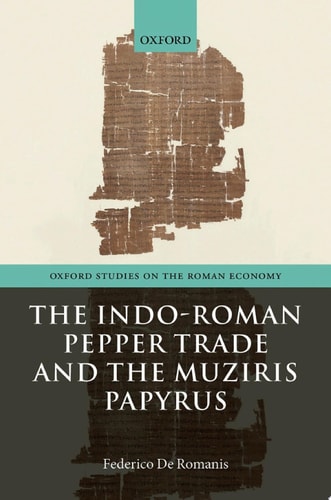
The Indo-Roman Pepper Trade and the Muziris Papyrus
0
0
As an Amazon Associate and affiliate partner, Menrva Books earns from qualifying purchases. Learn more
Author Description
This volume presents a systematic and fresh interpretation of a mid-second-century AD papyrus - the so-called Muziris papyrus - which preserves on its two sides fragments of a unique pair of documents: on one side, a loan agreement to finance a commercial enterprise to South India and, on the other, an assessment of the fiscal value of a South Indian cargo imported on a ship named the Hermapollon. The two texts, whose informative potential has long been underexploited, clarify several aspects of the early Roman Empire's trade with South India, including transport logistics, financial and legal elements in the loan agreement funding the commercial enterprise, the trade goods included in the South Indian cargo, and the technicalities of calculating and collecting Roman customs duties on the Indian imports. This study also considers imperial fiscal policy as it related to the South Indian trade, the overall evolution of Rome's trade relations with South India, the structure and organization of South Indian trade stakeholders, and the role played by private tax-collectors. The in-depth analysis sheds new light on this important sector of the Roman economy during the first two centuries AD in two innovative ways: through a balanced consideration of South Indian sources and data, and by drawing comparisons with the pepper trade from late antiquity, the Middle Ages, and early modernity, resulting in a longue durée perspective on the western trade in South Indian pepper.
Menrva's Summary
THE THESIS
This study investigates the economic mechanics and fiscal implications of the Roman trade with South India as evidenced by the mid-second-century AD Muziris papyrus. Federico De Romanis, a scholar specializing in the economic history of the Roman Empire, utilizes this rare document to reconstruct the logistics of long-distance maritime commerce. By analyzing the loan agreement and customs assessment preserved on the papyrus, the author constructs a framework for understanding how private capital and imperial fiscal policy intersected in the spice trade.
THE SCOPE MAP
What You Will Find
- Detailed analysis of the Muziris papyrus text and its legal implications.
- Examination of Roman customs duties and fiscal collection methods.
- Comparative analysis of pepper trade logistics across antiquity, the Middle Ages, and early modernity.
- Insights into the organization of commercial stakeholders and private tax-collectors.
Scope Limits
- The study focuses primarily on the economic and fiscal aspects of the trade rather than the cultural or social history of the Indian regions involved.
- It does not provide a comprehensive history of all Roman maritime trade routes, concentrating specifically on the South Indian pepper trade.
THE AUTHORITY PERSPECTIVE
Experts recognize this work as a significant contribution to the study of Roman economic history, particularly for its rigorous treatment of the Muziris papyrus. Readers frequently note the academic density of the prose, which is tailored for scholars and students of classical antiquity and economic history.
Page Count:
407
Publication Date:
2020-01-01
Publisher:
OUP Oxford
ISBN-10:
0192579754
ISBN-13:
9780192579751
Economics
History
Roman Empire
Ancient History
Trade and Commerce