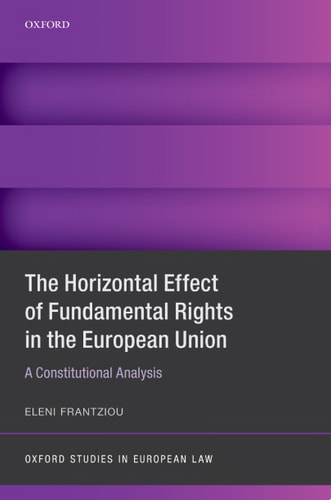
The Horizontal Effect of Fundamental Rights in the European Union
0
0
As an Amazon Associate and affiliate partner, Menrva Books earns from qualifying purchases. Learn more
Author Description
This Book Analyses The Horizontal Effect Of Fundamental Rights In The European Union, From A Constitutional Perspective. It Advances Two Main Arguments: First, It Argues That The Horizontal Effect Of Fundamental Rights (i.e. Their Application To Disputes Between Private Parties) Cannot Be Usefully Discussed Based On The Existing Eu Horizontality Doctrine, Which Associates Horizontality With The Exercise Of Horizontal Direct Effect Only. That Doctrine Is Characterised By A Series Of Overly Technical Rules As To How The Latter May Be Produced And Has A Case-specific Nature That Lacks Overall Constitutional Coherence. Secondly, The Book Argues That A Substantive Theory Of Horizontality Is Required In Eu Law And Sketches Its Main Parameters. In The Fundamental Rights Context, Horizontal Effect Has Organisational Implications For Society, Which Go Beyond Specific Intersubjective Disputes. It Is Argued That Its Determination Requires An Explicit Recognition Of The Public Character Of Certain Private Platforms Of Will Formation (e.g. The Workplace) And A Discussion Of The Role Of Fundamental Rights Therein. At The Same Time, A Constitutionally Adequate Model Of Horizontality Involves An Acknowledgment Of The Supranational Character Of Eu Adjudication: The Determination Of Horizontal Applicability Of A Fundamental Right Within A Type Of Private Authority Relationship Falls Upon The Court Of Justice, But The Precise Manifestation Of Horizontal Effect (e.g. Direct, Indirect Or State-mediated Effect) Rests With National Courts.
Menrva's Summary
THE THESIS
This book investigates the constitutional framework and theoretical coherence of the horizontal effect of fundamental rights within the European Union legal system. Eleni Frantziou, a legal scholar, critiques the current reliance on the EU horizontality doctrine, which she identifies as overly technical and lacking in constitutional consistency. She proposes a substantive theory of horizontality that accounts for the public character of private platforms and the division of labor between the Court of Justice and national courts.
THE SCOPE MAP
What You Will Find
- Analysis of the current EU horizontality doctrine and its limitations.
- A proposed substantive theory for the application of fundamental rights in private disputes.
- Examination of the public character of private platforms such as the workplace.
- A model for the division of responsibilities between supranational and national judicial bodies.
Scope Limits
- The book does not provide a comprehensive case-by-case manual for every specific EU directive.
- It focuses primarily on the constitutional and theoretical dimensions rather than purely procedural litigation tactics.
THE AUTHORITY PERSPECTIVE
Legal scholars and practitioners frequently cite this work for its rigorous critique of existing EU doctrines and its constructive proposal for a more coherent constitutional framework. Experts highlight the text as a significant contribution to the discourse on the intersection of private law and fundamental rights in a supranational context.
Page Count:
351
Publication Date:
2019-01-01
Publisher:
Oxford University Press
ISBN-10:
0192573993
ISBN-13:
9780192573995
Human rights
Law
European Union
Legal Theory
Constitutional Law
Community Tags
Similar Books