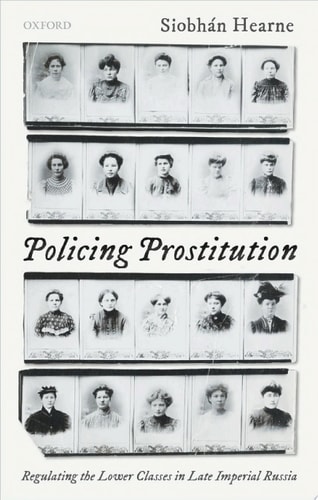
Policing Prostitution: Regulating the Lower Classes in Late Imperial Russia
0
0
As an Amazon Associate and affiliate partner, Menrva Books earns from qualifying purchases. Learn more
Author Description
Policing Prostitution examines the complex world of commercial sex in the late Russian Empire. From the 1840s until 1917, prostitution was legally tolerated across the Russian Empire under a system known as regulation. Medical police were in charge of compiling information about registered prostitutes and ensuring that they followed the strict rules prescribed by the imperial state governing their visibility and behaviour. The vast majority of women who sold sex hailed from the lower classes, as did their managers and clients. This study examines how regulation was implemented, experienced, and resisted amid rapid urbanization, industrialization, and modernization around the turn of the twentieth century. Each chapter examines the lives and challenges of different groups who engaged with the world of prostitution, including women who sold sex, the men who paid for it, mediators, the police, and wider urban communities. Drawing on archival material from Russia, Ukraine, Belarus, Latvia, Lithuania, and Estonia, Policing Prostitution illustrates how prostitution was an acknowledged, contested, and ever-present component of lower-class urban society in the late imperial period. In principle, the tsarist state regulated prostitution in the name of public order and public health; in practice, that regulation was both modulated by provincial police forces who had different local priorities, resources, and strategies, and contested by registered prostitutes, brothel madams, and others who interacted with the world of commercial sex.
Menrva's Summary
THE THESIS
This study investigates how the tsarist Russian state attempted to manage commercial sex through a system of medical police regulation between the 1840s and 1917. Siobhán Hearne, a historian specializing in the late Russian Empire, utilizes extensive archival records from across the former imperial territories to analyze the intersection of state policy and lower-class urban life. The book argues that while the state framed regulation as a matter of public health and order, the actual implementation was a contested process shaped by local police priorities and the agency of those involved in the sex trade.
THE SCOPE MAP
What You Will Find
- Analysis of the medical police system and its administrative requirements for registered sex workers.
- Examination of the socioeconomic backgrounds of sex workers, clients, and brothel managers.
- Comparative study of regulation implementation across Russia, Ukraine, Belarus, Latvia, Lithuania, and Estonia.
Scope Limits
- The study focuses primarily on the late imperial period and does not extend into the post-revolutionary Soviet era.
- The analysis is centered on the state-sanctioned regulation system rather than the entirety of the informal or underground sex economy.
THE AUTHORITY PERSPECTIVE
Scholars in the field of Russian social history recognize this work as a significant contribution to understanding the intersection of state power and marginalized populations. The text is noted for its rigorous use of multi-regional archival sources to challenge monolithic views of tsarist administrative control.
Page Count:
232
Publication Date:
2021-01-01
Publisher:
OUP Oxford
ISBN-10:
0192574965
ISBN-13:
9780192574961
History
Gender Studies
Russian History
European History
Social History
Sociology
Community Tags
Similar Books