Leibniz: Dissertation on Combinatorial Art
0
0
As an Amazon Associate and affiliate partner, Menrva Books earns from qualifying purchases. Learn more
Author Description
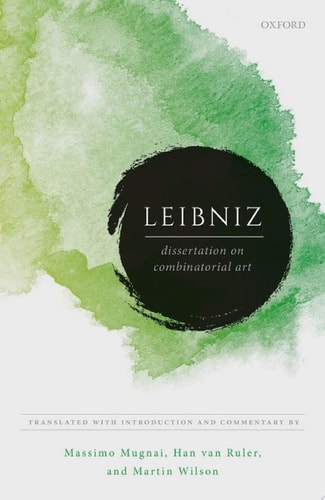
Leibniz published the Dissertation on Combinatorial Art in 1666. This book contains the seeds of Leibniz's mature thought, as well as many of the mathematical ideas that he would go on to further develop after the invention of the calculus. It is in the Dissertation, for instance, that we find the project for the construction of a logical calculus clearly expressed for the first time. The idea of encoding terms and propositions by means of numbers, later developed by Kurt Gödel, also appears in this work. In this text, furthermore, Leibniz conceives the possibility of constituting a universal language or universal characteristic, a project that he would pursue for the rest of his life. Mugnai, van Ruler, and Wilson present the first full English translation of the Dissertation, complete with a critical introduction and a comprehensive commentary.
Menrva's Summary
THE THESIS
This work investigates the foundational concepts of Gottfried Wilhelm Leibniz's early philosophical and mathematical framework as presented in his 1666 treatise. The authors, Massimo Mugnai, Han van Ruler, and Martin N. Wilson, provide a scholarly translation and critical apparatus to contextualize how these early ideas regarding combinatorial logic and universal language prefigure Leibniz's later contributions to calculus and formal logic.
THE SCOPE MAP
What You Will Find
- A complete English translation of the 1666 Dissertation on Combinatorial Art
- Analysis of the early development of logical calculus
- Historical context regarding the project of a universal characteristic
- Commentary on the numerical encoding of propositions
Scope Limits
- Does not cover Leibniz's entire philosophical corpus
- Focuses primarily on the 1666 text rather than his later mature works
THE AUTHORITY PERSPECTIVE
Scholars and historians of philosophy recognize this volume as a critical resource for understanding the genesis of Leibnizian thought. Experts highlight the precision of the translation and the utility of the commentary for those studying the history of formal logic and mathematics.
Page Count:
320
Publication Date:
2020-01-01
Publisher:
OUP Oxford
ISBN-10:
0192575112
ISBN-13:
9780192575111
Philosophy
Translation
Mathematics Statistics
History & Surveys
Logic
Logic & Critical Reasoning
Science History
Mathematics - General
Mathematics
Academic
Community Tags
Similar Books