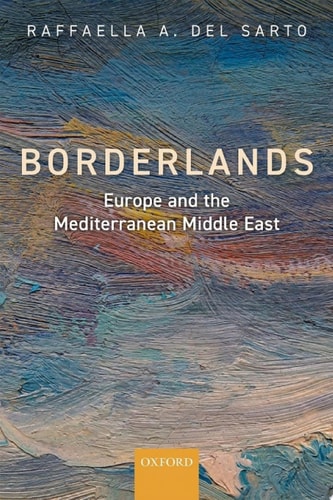
Borderlands: Europe and the Mediterranean Middle East
0
0
As an Amazon Associate and affiliate partner, Menrva Books earns from qualifying purchases. Learn more
Author Description
This is an open access title available under the terms of a CC BY-NC-ND 4.0 International licence. It is free to read at Oxford Scholarship Online and offered as a free PDF download from OUP and selected open access locations. Borderlands: Europe and the Mediterranean Middle East proposes a profound rethink of the complex relationship between Europe-defined here as the European Union and its members-and the states of the Mediterranean Middle East and North Africa (MENA), Europe's 'southern neighbours'. These relations are examined through a borderlands prism that conceives of this interaction as of one between an empire of sorts, which seeks to export its order beyond the border, and the empire's southern borderlands. Focusing on trade relations on the one hand, and the cooperation on migration, borders, and security on the other, the book revisits the historical origins and modalities of Europe's selective rule transfer to MENA states, the interests underwriting these policies, and the complex dynamics marking the interaction between the two sides over a twenty-year period (1995-2015). It shows that within a system of structurally asymmetric economic relations from which Europe and MENA elites benefit the most, single MENA governments have been co-opted into the management of border and migration control where they act as Europe's gatekeepers. Combined with specific policy choices of MENA governments, Europe's selective expansion of its rules, practices, and disaggregated borders have in fact contributed to rising socio-economic inequalities and the strengthening of authoritarian rule in the 'southern neighbourhood', with Europe tacitly tolerating serious violations of the rights of refugees and migrants at its fringes. Challenging the self-proclaimed benevolent nature of European policies and the notion of 'Fortress Europe' alike, the findings of this study contribute to broader debates on power, dependence, and interdependence in the discipline of International Relations.
Menrva's Summary
THE THESIS
This book investigates the power dynamics and structural asymmetries defining the relationship between the European Union and its Mediterranean Middle East and North African (MENA) neighbors. Raffaella A. Del Sarto, an expert in Middle East politics and international relations, utilizes a borderlands framework to analyze how European policies have historically influenced the political and economic stability of the MENA region. By examining trade, security, and migration policies, the author argues that European efforts to export order have inadvertently reinforced authoritarianism and exacerbated socio-economic inequality in the southern neighborhood.
THE SCOPE MAP
What You Will Find
- A twenty-year longitudinal analysis of EU-MENA relations from 1995 to 2015.
- An examination of trade agreements and their impact on regional economic structures.
- A detailed study of migration control policies and the role of MENA states as European gatekeepers.
- A critique of the 'borderlands' prism as a tool for understanding imperial-style influence.
Scope Limits
- The study focuses primarily on the period ending in 2015 and does not cover subsequent geopolitical shifts.
- The analysis is limited to the specific interaction between the EU and its southern neighbors, excluding broader global policy implications.
THE AUTHORITY PERSPECTIVE
Scholars in the field of international relations recognize this work as a critical contribution to the study of European foreign policy and regional hegemony. Readers frequently note the academic density of the prose and the rigorous application of the borderlands framework to contemporary political issues.
Page Count:
204
Publication Date:
2021-01-01
Publisher:
OUP Oxford
ISBN-10:
0192570110
ISBN-13:
9780192570116
International relations
Middle Eastern
Migration Studies
European Union
Geopolitics
Community Tags
Similar Books