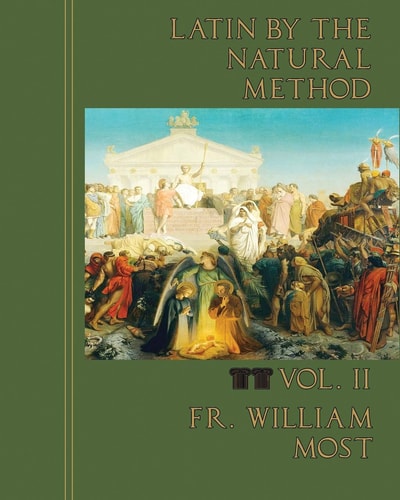
Latin by the Natural Method, Vol. 2
0
0
As an Amazon Associate and affiliate partner, Menrva Books earns from qualifying purchases. Learn more
Author Description
Most Americans who have studied Latin, with our priests and seminarians included, have employed this method, which they thought was 'traditional'. But as something fully developed, this tradition scarcely goes farther back than 1880; and even in its beginnings it hardly antedates the seventeenth century. In contrast to this method of grammatical analysis, Father Most's textbooks reproduce much of the "natural method" by which children learn their native language. Hence, the significance of Father Most's books is manifestly great for the Latin classes in any Catholic high schools or colleges. So much of our Catholic doctrine and culture have been deposited in Latin that we want many of our educated Catholics to be able to use Latin with ease. But the special significance of Father Most's texts is for the Latin classes in our seminaries. Here the students still have much the same cogent motives to master the art of using Latin with ease as the pupils of the thirteenth or sixteenth century. They need it as an indispensable means of communicating thought in their higher studies, and afterwards throughout life. The objectives (knowledge about Latin and training of mind) and corresponding methods (grammatical analysis and translation) "traditional" since 1880 have taken over in our seminaries; and there too the students have been experiencing an ever growing inability to use Latin. Father Most's textbooks can contribute much towards revolutionizing the teaching of Latin by bringing back, as the chief objective, the art of reading, writing, and (when desired) speaking Latin with ease." Fr. Most's textbooks can be classed in categories of similar texts, such as Hans Ørberg's Lingua Latina, as well as Ecce Romani which is a simplification of Ørberg or others which aim to teach Latin not even so much as a modern language, as to teach it by a method more natural to the philosophy of learning Languages. Fr. Most's text follows the view that Latin of the late
Menrva's Summary
THE THESIS
This book aims to revitalize the teaching of Latin by reintroducing a 'natural method' of language acquisition, contrasting with the traditional grammatical analysis prevalent since the late 19th century. Fr. William G. Most, drawing on his extensive experience and understanding of Catholic doctrine's reliance on Latin, argues that traditional methods have led to an increasing inability for students to use the language effectively. His textbooks are designed to mirror how children learn their native tongue, focusing on reading, writing, and speaking Latin with ease, a goal he posits was central to classical and medieval Latin education. The method is compared to other natural language learning approaches like Hans Ørberg's Lingua Latina, emphasizing a more intuitive acquisition process.
THE SCOPE MAP
- A pedagogical approach focused on the 'natural method' of language acquisition.
- Content designed to facilitate reading, writing, and speaking Latin with ease.
- A critique of traditional Latin teaching methods prevalent since the late 19th century.
- Emphasis on the historical and cultural significance of Latin, particularly within Catholic education.
- Comparison to other modern language learning texts such as Lingua Latina.
THE AUTHORITY PERSPECTIVE
The approach presented in Fr. Most's textbooks is positioned as a significant departure from the dominant 'traditional' methods of Latin instruction, which are characterized as overly reliant on grammatical analysis. The text suggests that these traditional methods have led to a decline in students' ability to use Latin effectively, despite its continued importance in Catholic doctrine and culture. By advocating for a return to a more natural method, akin to how children learn their first language, the book aims to revolutionize Latin education. Its significance is highlighted for both Catholic high schools and seminaries, where a strong command of Latin is deemed essential for higher studies and lifelong communication.
Page Count:
294
Publication Date:
2015-11-30
Publisher:
Mediatrix Press
ISBN-10:
1735060151
ISBN-13:
9781735060156
Non-Fiction
Education
Community Tags
Similar Books