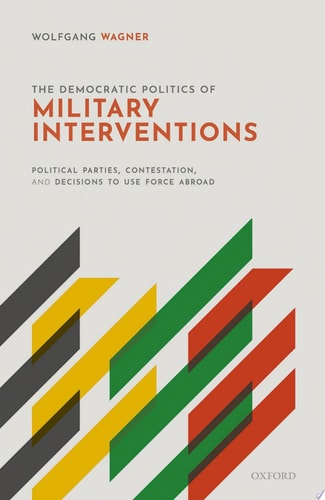
The Democratic Politics of Military Interventions: Political Parties, Contestation, and Decisions to Use Force Abroad
0
0
As an Amazon Associate and affiliate partner, Menrva Books earns from qualifying purchases. Learn more
Author Description
Cover -- The Democratic Politics Of Military Interventions: Political Parties, Contestation, And Decisions To Use Force Abroad -- Copyright -- Preface And Acknowledgements -- Contents -- List Of Figures -- List Of Tables -- List Of Abbreviations -- Chapter 1: Introduction And Plan Of The Book -- 1.1 The 'neglected Element': Political Parties And Foreign Affairs -- 1.2 Which Parties? Which Policies? -- 1.3 Plan Of The Book -- Chapter 2: Democratic Politics And Foreign Affairs: A Theoretical Framework 2.1 The Normative Debate: The (in)compatibility Of Democratic Politics With International Conflict And Security -- 2.2 Zooming In On The Democratic Politics Of International Conflict: The Democratic Peace Debate And Beyond -- 2.2.1 Democratic Institutions -- 2.2.2 Liberal Ideas And Political Culture: Ambivalence And Diversity -- 2.3 Differences Among Democracies And Party-political Orientation Of Government -- 2.4 Conclusion -- Chapter 3: Contestation And Politicization Of Security And Defence Policy -- 3.1 Contestation And Politicization -- 3.2 Methodology 3.3 Long-term Patterns Of Contestation: Congressional Voting Between 1789 And 2014 -- 3.4 Foreign, Security, And Defence Policy Votes In Germany And The Netherlands -- 3.5 Deployment Votes -- 3.5.1 Us Declarations Of War And Authorizations To Use Force -- 3.5.2 Deployment Votes Since The End Of The Cold War -- 3.6 Conclusion -- Chapter 4: The Party Politics Of Foreign And Security Policy -- 4.1 Why Political Parties Differ -- 4.2 How Political Parties Differ: The Left/right And The 'new Politics' Dimensions 4.3 Dimensions Of Party-political Contestation: Evidence From Manifestos, Experts, And Parliamentary Votes -- 4.3.1 Pro Or Against The Military And Security And Defence Policy: Evidence From Party Manifestos -- 4.3.2 Pro Or Against Peace And Security Missions: Evidence From Expert Surveys -- 4.3.3 Pro Or Against Actual Military Deployments: Evidence From Votes In Parliament -- 4.4 Conclusion -- Chapter 5: Debating
Menrva's Summary
THE THESIS
This book investigates how domestic political party competition and ideological orientation influence the decision-making processes behind military interventions in democratic states. Wolfgang Wagner, a scholar of international relations and security policy, utilizes a comparative framework to analyze how partisan divides shape foreign policy outcomes. By examining legislative voting patterns and party manifestos, the author argues that internal democratic contestation is a primary, yet often overlooked, driver of international security behavior.
THE SCOPE MAP
What You Will Find
- Longitudinal analysis of congressional voting records from 1789 to 2014.
- Comparative case studies focusing on the United States, Germany, and the Netherlands.
- Quantitative evidence derived from party manifestos and expert surveys regarding military deployment.
- A theoretical framework linking domestic party politics to foreign policy decision-making.
Scope Limits
- The analysis does not cover non-democratic regimes or authoritarian decision-making structures.
- The text focuses primarily on parliamentary and congressional processes rather than executive-level intelligence or covert operations.
THE AUTHORITY PERSPECTIVE
Scholars in the field of international relations recognize this work as a rigorous examination of the intersection between domestic partisanship and foreign policy. Readers frequently note the academic density of the prose and the extensive use of historical data to support the author's institutional arguments.
Page Count:
208
Publication Date:
2020-01-01
Publisher:
Oxford University Press,
ISBN-10:
0192586017
ISBN-13:
9780192586018
International relations
Security Studies
Public Policy
Military History
Government
Community Tags
Similar Books







Reader Comments
Share Your Thoughts
No comments yet. Be the first to share your thoughts!