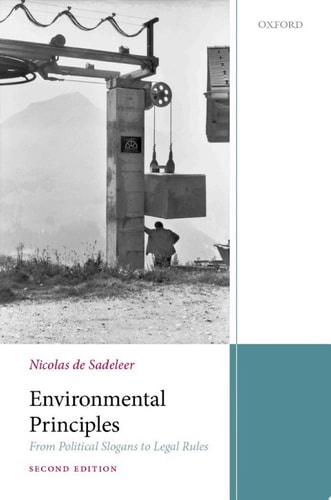
Environmental Principles: From Political Slogans to Legal Rules
0
0
As an Amazon Associate and affiliate partner, Menrva Books earns from qualifying purchases. Learn more
Author Description
This book traces the evolution of environmental principles from their origins as vague political slogans reflecting fears about environmental hazards to their embodiment in enforceable laws. Environmental law has always responded to risks posed by industrial society but the new generation of risks have required a new set of environmental principles, emerging from a combination of public fears, science, ethics, and established legal practice. This book shows how three of the most important principles of modern environmental law grew out of this new age of ecological risk: the polluter pays principle, the preventive principle, and the precautionary principle. Since the first edition was published, the principles of polluter-pays, prevention, and precaution have been encapsulated in a swathe of legislation at domestic and international level. Courts have been invoking environmental law principles in a broad range of cases, on issues including GMOs, conservation, investment, waste, and climate change. As a result, more States are paying heed to these principles as catalysts for improving their environmental laws and regulations. This edition will integrate to a greater extent the relationship between environmental principles and human rights. The book analyses new developments including the EU Charter of Fundamental Rights, the case law of the European Court of Human Rights, which has continuously carved out environmental duties from a number of rights enshrined in the European Convention of Human Rights, and the implementation of the UNECE Convention on Access to Information.
Menrva's Summary
THE THESIS
This book investigates how environmental principles have transitioned from abstract political rhetoric into concrete, enforceable legal standards within domestic and international frameworks. Nicolas de Sadeleer, a scholar specializing in environmental law, examines the intersection of public concern, scientific advancement, and ethical considerations that necessitated this legal evolution. The text argues that modern environmental governance relies on the codification of specific principles to manage the complex risks inherent in industrial society.
THE SCOPE MAP
What You Will Find
- Analysis of the polluter pays, preventive, and precautionary principles
- Examination of the relationship between environmental law and human rights
- Review of case law from the European Court of Human Rights and the EU Charter of Fundamental Rights
Scope Limits
- The text focuses primarily on European and international legal frameworks rather than a global survey of all national jurisdictions
- It does not provide a comprehensive guide to environmental litigation strategy
THE AUTHORITY PERSPECTIVE
Legal scholars and practitioners frequently cite this work as a foundational text for understanding the normative development of environmental law. Readers often note the academic density of the prose, which is tailored for those with a background in jurisprudence or environmental policy.
Page Count:
590
Publication Date:
2020-01-01
Publisher:
OUP Oxford
ISBN-10:
0192582674
ISBN-13:
9780192582676
Public Policy
Professional Career & Trade
International Law
Legal Theory
Community Tags
Similar Books