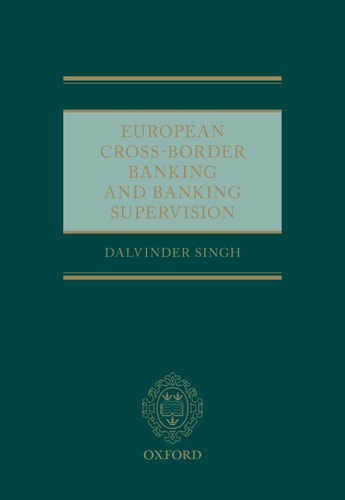
European Cross-Border Banking and Banking Supervision
0
0
As an Amazon Associate and affiliate partner, Menrva Books earns from qualifying purchases. Learn more
Author Description
This new work provides timely analysis of the cross-border exercise of banking activity in the EU and its supervision, from the perspective of the 'home-host rule'. It examines the current system and the efficacy of recent reforms considering whether the centralisation of decision making and a more effective mutualisation of financing tools could improve the safety and soundness of the EU banking system and reduce the asymmetry of information between home and host authorities. The EU banking market is very integrated since banking institutions based in the Union are free to perform their activities within the single market. This has allowed EU banking institutions to significantly increase their cross border operations. This way of working is based on the home country control principle according to which EU institutions performing cross border activities continue to be supervised by their home country supervisor. However, this system has raised challenges for effectively performing supervision, resolution and crisis management of banking groups operating across the borders of many different jurisdictions. This book analyses how far recent reforms under the banking union regime have addressed these issues to ensure the integrity and stability of the European integration project. It utilises data to illustrate the cross border exposures between member states and how they influence home and host decision making. But it equally explores those areas that still remain within the national discretion such as non-performing loans, insolvency-liquidation of banks and deposit protection arrangements, to mention a few. The book analyses the main pillars of the banking union: the single supervisory mechanism (SSM); and the Single Resolution Mechanism (SRM) and the proposed European Deposit Insurance Scheme (EDIS); and the related tools designed to provide crisis management under the European Stability Mechanism (ESM). As such the work considers the impact of the Single Rulebook.
Menrva's Summary
THE THESIS
This book investigates whether the centralization of decision-making and the mutualization of financing tools can effectively enhance the safety and stability of the European Union banking system while mitigating information asymmetry between home and host authorities. Dalvinder Singh, an expert in financial regulation, evaluates the efficacy of the current home-host supervision model in light of recent reforms. The text provides a critical assessment of the Banking Union framework, examining how institutional structures influence cross-border banking operations and crisis management across diverse jurisdictions.
THE SCOPE MAP
What You Will Find
- Analysis of the Single Supervisory Mechanism (SSM) and Single Resolution Mechanism (SRM).
- Evaluation of the European Deposit Insurance Scheme (EDIS) and the European Stability Mechanism (ESM).
- Examination of cross-border exposures and their impact on regulatory decision-making.
- Discussion of the Single Rulebook and its role in European financial integration.
Scope Limits
- The text does not provide a comprehensive guide to national-level insolvency procedures.
- It does not cover the entirety of retail banking operational strategies outside of regulatory compliance.
THE AUTHORITY PERSPECTIVE
Experts identify this work as a rigorous examination of the structural challenges inherent in the European Banking Union. Readers frequently note the academic density of the prose, which serves as a specialized resource for legal scholars and financial regulators.
Page Count:
313
Publication Date:
2020-01-01
Publisher:
OUP Oxford
ISBN-10:
0192583158
ISBN-13:
9780192583154
Economics
European Union
Professional Career & Trade
Finance
International Law
Community Tags
Other Editions(2)
Similar Books














Reader Comments
Share Your Thoughts
No comments yet. Be the first to share your thoughts!