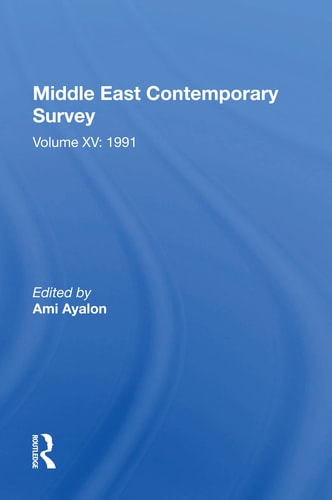
Middle East Contemporary Survey Volume XV: 1991
0
0
As an Amazon Associate and affiliate partner, Menrva Books earns from qualifying purchases. Learn more
Author Description
This is the fifteenth volume in a series that provides up-to-date summation and evaluation of the rapidly changing events in an exceptionally complex region of the world. This volume covers the period January through December 1991 and offers in-depth analysis of the Gulf War, the U.S.-inspired peace negotiations, the surge of Islamic sentiment in a number of countries, and inter-Arab relations in the wake of the Gulf War. In addition, a comprehensive survey of the affairs of each country is provided. This volume covers the year 1991, a watershed period in the Middle East. The Gulf War pitted regional and international forces of unprecedented might against each other in fierce confrontation. Local and global developments, such as the U.S.-led victory over Iraq and the disintegration of the Soviet Union, brought on the struggle for a new order in the region. The relevance of Western political modes for Middle Eastern societies was again raised for examination, highlighting the formidable complexities of such options. One of the local responses to these changes was a surge of Islamic sentiment sometimes militant in nature manifested primarily in Sudan, Algeria, Jordan, Egypt, and among the Palestinians. Spearheaded by the United States, the Middle East peace process entered a more dynamic phase, as a multilateral peace conference in Madrid ushered in a new era of direct Arab-Israeli negotiations. The Arab system was slow to recover from the painful impact of the Gulf War, and inter-Arab relations continued to be characterized more by mutual vindictiveness than by reconciliation. On the whole, this was a year of considerable flux and uncertainty, with some events promising the inauguration of a new course of development for the region and others passing without long-term impact. The period surveyed in this volume, unless otherwise indicated, is from January to December 1991. In order to avoid excessive repetition while achieving a comprehensive survey of the affairs of
Menrva's Summary
THE THESIS
This volume critically examines the tumultuous events of 1991 in the Middle East, a year marked by the Gulf War and the subsequent reordering of regional and international relations. Ami Ayalon, a noted historian and scholar of the Middle East, synthesizes contemporary events using a wealth of primary sources and expert analysis to evaluate the impact of the Gulf War, the nascent peace process, the rise of Islamic sentiment, and shifting inter-Arab dynamics. The book's central argument revolves around the profound flux and uncertainty of the period, exploring both the potential for new regional developments and the persistence of unresolved conflicts.
THE SCOPE MAP
- In-depth analysis of the Gulf War and its immediate aftermath.
- Examination of the U.S.-inspired Middle East peace negotiations, including the Madrid Conference.
- Survey of the surge of Islamic sentiment across various countries like Sudan, Algeria, Jordan, Egypt, and among Palestinians.
- Analysis of inter-Arab relations in the post-Gulf War era.
- Comprehensive country-by-country survey of affairs for the year 1991.
- Discussion on the relevance of Western political models in Middle Eastern societies.
- Evaluation of the disintegration of the Soviet Union's impact on the region.
THE AUTHORITY PERSPECTIVE
As the fifteenth volume in a respected series, this work is positioned as a crucial analytical tool for understanding contemporary Middle Eastern affairs. The detailed scope, covering major geopolitical events, internal political shifts, and the complex interplay of regional actors, suggests a text aimed at scholars, policymakers, and informed general readers. The comprehensive approach, integrating analysis of both international and local factors, indicates a rigorous academic standard for evaluating the year's watershed developments.
Page Count:
804
Publication Date:
2023-06-13
Publisher:
Taylor & Francis Group
ISBN-10:
0367158752
ISBN-13:
9780367158750
History
Politics
Non-Fiction
Current Events
Community Tags
Similar Books