International Relations and Political Philosophy
0
0
As an Amazon Associate and affiliate partner, Menrva Books earns from qualifying purchases. Learn more
Author Description
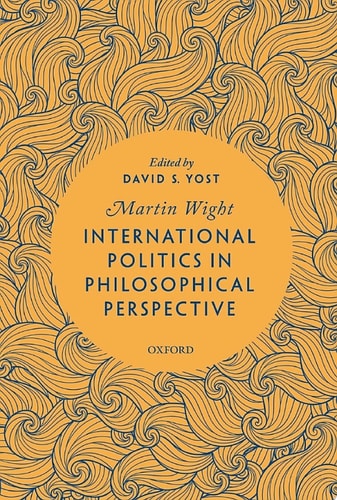
This book collects works by the late Professor Martin Wight (1913-1972), an historian and scholar of international relations. He conducted research on many topics, including British colonial history, European studies, international institutions, and the history and sociology of states-systems. He is nonetheless best known for his teaching about the political philosophy of international relations at the London School of Economics (1949-1961) and the University of Sussex (1961-1972). He is widely regarded as an intellectual ancestor and path-breaker of the 'English School' of international relations, even though this term only gained currency nine years after his death. While there is no generally accepted definition of the 'English School', it is usually construed as signifying an approach to the study of international relations more rooted in historical and humanistic learning than in the social sciences. Wight's achievements are consistent with this broad definition. This volume includes works in four categories: (a) traditions of thinking about international relations since the sixteenth century; (b) the causes and functions of war; (c) international and regime legitimacy; and (d) fortune and irony in international politics. In addition to classic essays such as 'Why Is There No International Theory?' and 'Western Values in International Relations' that complement his posthumous 1991 book International Theory: The Three Traditions, this volume includes previously unpublished works on international legitimacy and the causes of war. Wight's analysis of legitimacy examines the evolution of thinking from dynastic to popular approaches, while his work on the causes of war builds on Thucydides and Hobbes.
Menrva's Summary
THE THESIS
This volume investigates the foundational intellectual traditions and philosophical underpinnings that govern the conduct of international relations. Martin Wight, a prominent scholar and historian, utilizes a humanistic approach to analyze the evolution of state systems, the legitimacy of regimes, and the persistent causes of war. By synthesizing historical inquiry with political theory, the work argues that international relations must be understood through the lens of historical learning rather than purely quantitative social science.
THE SCOPE MAP
What You Will Find
- Analysis of international relations traditions since the sixteenth century
- Theoretical frameworks regarding the causes and functions of war
- Examinations of international and regime legitimacy
- Discussions on fortune and irony in global politics
- Previously unpublished essays alongside classic scholarly texts
Scope Limits
- The text does not provide a modern quantitative analysis of contemporary international relations
- It does not offer a comprehensive history of all global state systems, focusing primarily on Western traditions
THE AUTHORITY PERSPECTIVE
Scholars recognize this collection as a vital resource for understanding the intellectual origins of the English School of international relations. Readers frequently note the academic density of the prose, which serves as a foundational text for those studying the intersection of history and political theory.
Page Count:
384
Publication Date:
2022-01-01
Publisher:
OUP Oxford
ISBN-10:
0192587587
ISBN-13:
9780192587589
History
Political Philosophy
International relations
Academic
Community Tags
Similar Books