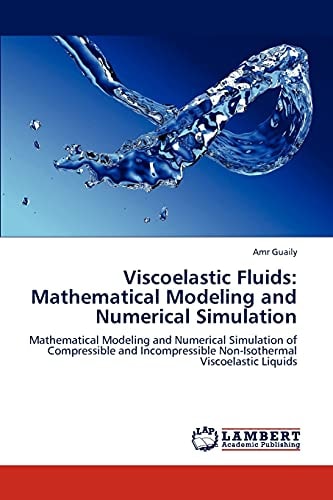
Viscoelastic Fluids: Mathematical Modeling and Numerical Simulation
0
0
As an Amazon Associate and affiliate partner, Menrva Books earns from qualifying purchases. Learn more
Author Description
Although viscoelastic flows are characterized by a very low Mach number regime, it involves a weakly compressible liquid phase, which requires a special treatment. This work is devoted to the mathematical modeling and numerical simulation for viscoelastic fluids. It follows directly a previous publication, PhD dissertation of the author. A Unified purely hyperbolic mathematical model for compressible and incompressible viscoelastic fluids is presented. To complete the mathematical model, a complete chapter is devoted to describe a new procedure to determine the correct type and number of boundary conditions for hyperbolic systems. Then a new model describing the non-isothermal viscoelastic flows is introduced while keeping the hyperbolic nature of the system. The main advantage of the proposed model over the existing ones is its hyperbolic nature, which overcomes some of the drawbacks of the available models. The proposed model is then solved numerically using a hybrid finite element/finite difference scheme.
Menrva's Summary
THE THESIS
This work presents a novel hyperbolic mathematical model for simulating viscoelastic fluid flows, addressing challenges in weakly compressible liquids. The author, Amr Guaily, builds upon his previous research to introduce a unified model applicable to both compressible and incompressible viscoelastic fluids. A dedicated chapter details a new procedure for determining boundary conditions for hyperbolic systems, ensuring model stability and accuracy. The research further extends to a new model for non-isothermal viscoelastic flows, maintaining the system's hyperbolic nature, which offers advantages over existing models by avoiding numerical instabilities.
THE SCOPE MAP
- A unified purely hyperbolic mathematical model for compressible and incompressible viscoelastic fluids.
- A new procedure for determining the correct type and number of boundary conditions for hyperbolic systems.
- A new model describing non-isothermal viscoelastic flows while maintaining hyperbolic characteristics.
- Numerical solution of the proposed model using a hybrid finite element/finite difference scheme.
THE AUTHORITY PERSPECTIVE
The book introduces a novel hyperbolic mathematical model for viscoelastic fluids, aiming to overcome limitations of existing models by maintaining a hyperbolic nature. The work is presented as a direct continuation of the author's prior dissertation, suggesting a deep dive into the theoretical underpinnings and numerical implementation. The focus on boundary condition determination for hyperbolic systems indicates a rigorous approach to ensuring the stability and accuracy of the simulations. The proposed model and its numerical solution via a hybrid scheme are central to the research's contribution.
Page Count:
156
Publication Date:
2011-10-01
Publisher:
Lap Lambert Academic Publishing GmbH KG
ISBN-10:
3846521000
ISBN-13:
9783846521007
Non-Fiction
Science
Mathematical Modeling
Fluid dynamics
Rheology
Community Tags
Similar Books