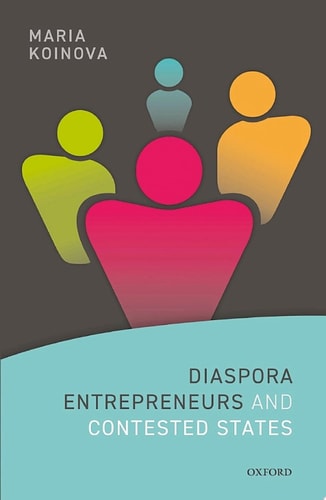
Diaspora Entrepreneurs and Contested States
0
0
As an Amazon Associate and affiliate partner, Menrva Books earns from qualifying purchases. Learn more
Author Description
Why do conflict-generated diasporas mobilize in contentious and non-contentious ways or use mixed strategies? This book develops a theory of socio-spatial positionality and its implications for the individual agency of diaspora entrepreneurs. A novel typology features four types of diaspora entrepreneurs—Broker, Local, Distant, and Reserved—depending on the relative strength of their socio-spatial linkages to host-land, original homeland, and other global locations. A two-level typological theory captures nine causal pathways unravelling how diaspora entrepreneurs operate in transnational social fields and interact with host-land foreign policies, homeland governments, parties, non-state actors, critical events, and limited global influences. Non-contention often occurs when diaspora entrepreneurs act autonomously and when host-state foreign policies converge with their goals. Dual-pronged contention is common under the influence of homeland governments, non-state actors, and political parties. The most contention occurs in response to violent events in the original homeland or adjacent to it fragile states. The book is informed by 300 interviews among the Albanian, Armenian, and Palestinian diasporas connected to de facto states, Kosovo, Nagorno-Karabakh, and Palestine respectively. Interviews were conducted in the UK, Germany, France, Netherlands, Sweden, Switzerland, Brussels in Belgium, as well as Kosovo and Armenia in the European neighbourhood.
Menrva's Summary
THE THESIS
This book investigates the mechanisms through which conflict-generated diasporas mobilize and exert agency within transnational social fields. Prof. Maria Koinova, a scholar specializing in diaspora mobilization and conflict, utilizes a socio-spatial positionality framework to analyze how individual diaspora entrepreneurs navigate complex political landscapes. By examining the interplay between personal agency and external pressures from host-land policies and homeland actors, the text provides a structured typology to explain why these groups choose contentious or non-contentious strategies.
THE SCOPE MAP
What You Will Find
- A novel typology categorizing diaspora entrepreneurs into Broker, Local, Distant, and Reserved types.
- A two-level theory identifying nine distinct causal pathways for mobilization.
- Analysis of interactions between diaspora actors and host-land foreign policies, political parties, and non-state entities.
Scope Limits
- The study focuses primarily on the Albanian, Armenian, and Palestinian diasporas.
- The research is geographically constrained to specific European host countries and the immediate neighborhoods of the relevant de facto states.
THE AUTHORITY PERSPECTIVE
Experts recognize this work as a significant contribution to the study of transnational political agency and diaspora mobilization. Readers frequently note the academic density of the prose and the rigor of the qualitative data derived from extensive field interviews.
Page Count:
374
Publication Date:
2021-01-01
Publisher:
OUP Oxford
ISBN-10:
0192588311
ISBN-13:
9780192588319
Sociology
Migration Studies
International relations
Conflict Studies
Community Tags
Similar Books