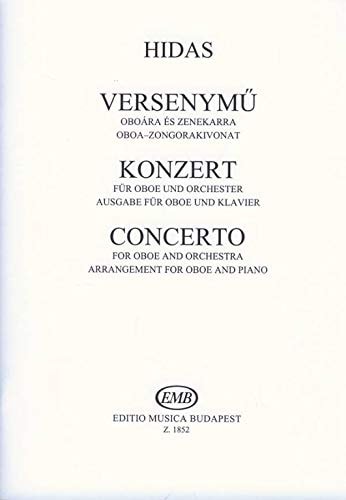
Concerto for Oboe and Orchestra (Oboe and Piano)
0
0
As an Amazon Associate and affiliate partner, Menrva Books earns from qualifying purchases. Learn more
Author Description
It's quite rare when a composer's diploma work becomes a successful, popular piece even after 70 years. Frigyes Hidas' (1928-2007) Oboe Concerto, written in 1951, is a work that Péter Pongrácz, Lajos Lencsés, and many other Hungarian and foreign oboists gladly add to their concert programs. It is difficult to pinpoint exactly what stylistic conventions helped to form the musical language of the Oboe Concerto: the three-movement form is suggestive of Viennese Classicism, and Hungarian motifs of the era can also be detected here and there. However, the main influences can be felt from the Neoclassicism of the 1920s and 1930s, the Baroque era, and the French woodwind school. As with all of his musical creations, Hidas demonstrates here that he is a master of instrumental knowledge, consideration towards his works' performers, and tasteful moderation. This publication is printed on high-quality, age-resistant, pale-yellow paper that is produced in an environmentally-friendly, climate-neutral manner using renewable raw materials.
Menrva's Summary
THE THESIS
This work investigates the enduring appeal and stylistic synthesis of Frigyes Hidas's 1951 Oboe Concerto, a piece that has maintained its place in the repertoire for over seven decades. Hidas, a composer noted for his technical mastery and consideration for performers, crafted a concerto that bridges multiple historical traditions. The text examines how the composition functions as a pedagogical and performance tool, balancing structural rigor with instrumental accessibility.
THE SCOPE MAP
What You Will Find
- A three-movement concerto structure for oboe and piano accompaniment
- Analysis of stylistic influences including Viennese Classicism, Hungarian folk motifs, and the French woodwind school
- Technical insights into the composer's approach to woodwind instrumentation
Scope Limits
- This publication does not provide a full orchestral score, focusing instead on the oboe and piano reduction
- The text does not offer a comprehensive biography of the composer beyond the context of this specific work
THE AUTHORITY PERSPECTIVE
Musicians and scholars recognize this concerto as a standard piece for advanced oboists, frequently performed by both Hungarian and international soloists. Experts highlight the work's technical balance and its successful integration of Neoclassical and Baroque elements.
Page Count:
68
Publication Date:
1955-01-01
Publisher:
Universal Music Publishing Editio Musica Budapest
ISBN-10:
0080018521
ISBN-13:
9780080018522
Music
Sheet Music
Oboe
Music
Concerto
Community Tags
Similar Books