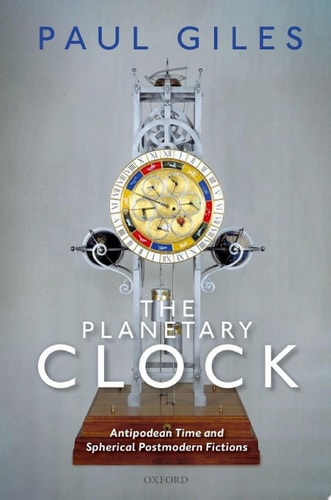
The Planetary Clock: Antipodean Time and Spherical Postmodern Fictions
0
0
As an Amazon Associate and affiliate partner, Menrva Books earns from qualifying purchases. Learn more
Author Description
The theme of The Planetary Clock is the representation of time in postmodern culture and the way temporality as a global phenomenon manifests itself differently across an antipodean axis. To trace postmodernism in an expansive spatial and temporal arc, from its formal experimentation in the 1960s to environmental concerns in the twenty-first century, is to describe a richer and more complex version of this cultural phenomenon. Exploring different scales of time from a Southern Hemisphere perspective, with a special emphasis on issues of Indigeneity and the Anthropocene, The Planetary Clock offers a wide-ranging, revisionist account of postmodernism, reinterpreting literature, film, music, and visual art of the post-1960 period within a planetary framework. By bringing the culture of Australia and New Zealand into dialogue with other Western narratives, it suggests how an antipodean impulse, involving the transposition of the world into different spatial and temporal dimensions, has long been an integral (if generally occluded) aspect of postmodernism. Taking its title from a Florentine clock designed in 1510 to measure worldly time alongside the rotation of the planets, The Planetary Clock ranges across well-known American postmodernists (John Barth, Toni Morrison) to more recent science fiction writers (Octavia Butler, Richard Powers), while bringing the US tradition into juxtaposition with both its English (Philip Larkin, Ian McEwan) and Australian (Les Murray, Alexis Wright) counterparts. By aligning cultural postmodernism with music (Messiaen, Ligeti, Birtwistle), the visual arts (Hockney, Blackman, Fiona Hall), and cinema (Rohmer, Haneke, Tarantino), this volume enlarges our understanding of global postmodernism for the twenty-first century.
Menrva's Summary
THE THESIS
This work investigates how the representation of time in postmodern culture functions differently when viewed through an antipodean, Southern Hemisphere perspective. Giles, a scholar of American and global literature, utilizes a framework that juxtaposes Western canonical narratives with Australian and New Zealand cultural outputs. By analyzing the transposition of spatial and temporal dimensions, he argues that the planetary scale is essential for understanding the evolution of postmodernism from the 1960s to the present era of the Anthropocene.
THE SCOPE MAP
What You Will Find
- Comparative analysis of literature, film, music, and visual arts across global regions.
- A theoretical framework centered on the 'antipodean impulse' and planetary time.
- Case studies ranging from John Barth and Toni Morrison to Octavia Butler and Alexis Wright.
Scope Limits
- The text does not provide an exhaustive history of postmodernism but focuses specifically on the intersection of time, space, and antipodean geography.
- It does not cover non-Western cultural traditions outside of the specific dialogue between the US, UK, and Oceania.
THE AUTHORITY PERSPECTIVE
Scholars and critics frequently note the academic density of the prose and the ambitious scope of the interdisciplinary connections. Experts highlight this as a significant contribution to the field of global postmodern studies, particularly for its focus on environmental and indigenous temporalities.
Page Count:
434
Publication Date:
2021-01-01
Publisher:
OUP Oxford
ISBN-10:
0192599518
ISBN-13:
9780192599513
Philosophy
English & College Success
Literary Criticism
Postmodernism
Art History
English
Community Tags
Similar Books