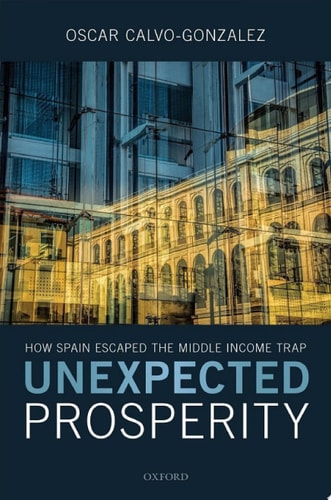
Unexpected Prosperity: How Spain Escaped the Middle Income Trap
0
0
As an Amazon Associate and affiliate partner, Menrva Books earns from qualifying purchases. Learn more
Author Description
Only a handful of economies have successfully transitioned from middle to high income in recent decades. One such case is Spain. How did it achieve this feat? Despite its relevance to countries that have yet to complete that transition, this question has attracted only limited attention. As a result, Spain's development into a prosperous society is a largely under-reported and often misunderstood success story. Unexpected Propserity takes a different look at the questions that usually frame the debate about Spain's economic development. Instead of asking why Spain's catching up was delayed, Calvo-Gonzalez asks how it happened in the first place; instead of focusing on how bad institutions undermined economic prospects, as the literature has done, he explains how growth took place even in the presence of poor institutions. This wider view opens new perspectives on Spain's development path. For example, comparisons are drawn not only with the richest countries but also with those that were in a similar stage of development as Spain. Drawing on a wide range of material, from archival sources to text analytics, the book provides a new account of why reforms were adopted, the role of external and internal factors, as well as that of unintended consequences. The result is an original interpretation of the economic rise of Spain that speaks also to the wider literature on the political economy of reform, the role of industrial and public policy more broadly, and the enduring legacy of political violence and conflict.
Menrva's Summary
THE THESIS
This book investigates the mechanisms by which Spain successfully transitioned from a middle-income to a high-income economy despite the presence of suboptimal institutional frameworks. Oscar Calvo-Gonzalez, an economist with extensive experience in development policy, challenges conventional narratives that focus on institutional failure. By analyzing historical data and policy reforms, he argues that growth occurred through a complex interplay of internal and external factors, often succeeding in spite of, rather than because of, existing political structures.
THE SCOPE MAP
What You Will Find
- Comparative analysis between Spain and other economies at similar development stages
- Application of text analytics to historical archival sources
- Examination of the political economy of reform and industrial policy
- Analysis of the long-term impact of political violence and conflict on economic trajectory
Scope Limits
- Does not provide a comprehensive history of Spanish macroeconomics
- Does not focus on the post-2008 economic crisis period
THE AUTHORITY PERSPECTIVE
Experts recognize this work as a significant contribution to the literature on development economics and the political economy of reform. Readers frequently note the author's ability to synthesize archival research with modern analytical techniques to provide a nuanced view of Spanish economic history.
Page Count:
308
Publication Date:
2021-01-01
Publisher:
OUP Oxford
ISBN-10:
019259575X
ISBN-13:
9780192595751
Economics
Economics history
Spain
Economic History
Community Tags
Similar Books