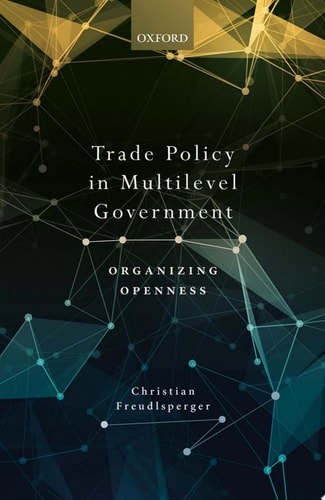
Trade Policy in Multilevel Government: Organizing Openness
0
0
As an Amazon Associate and affiliate partner, Menrva Books earns from qualifying purchases. Learn more
Author Description
Cover -- Trade Policy In Multilevel Government: Organizing Openness -- Copyright -- Acknowledgements -- Contents -- List Of Figures -- List Of Tables -- List Of Abbreviations -- 1: Introduction: The Rise Of Multilevel Trade Governance -- Theoretical Argument And Contribution -- The Case Of Procurement Liberalization -- Findings -- Book Outline -- 2: More Voice, Less Exit: The Dynamics Of Multilevel Trade Governance -- 2.1 Federalism, Multilevel Government, And The European Union -- 2.2 The Dynamic Nature Of Multilevel Government -- 2.3 Voice And Exit In Multilevel Trade Governance The Inverse Relationship Between Constituent Units' Voice And Exit -- Voice In Different Varieties Of Multilevel Government -- Voice In The Council And Senate Varieties Of Multilevel Government -- Voice In Collaborative And Competitive Vertical Relations -- Market Integration And Politicization As Intervening Factors -- 2.4 Case Selection -- 2.5 Method Of Comparison And Empirical Data Base -- Summary -- 3: Resisting Openness: Subcentral Governments And Procurement Liberalization -- 3.1 The Significance Of Public Procurement In Multilevel Government 3.2 The Emergence Of An International Regime On Public Procurement -- The Procurement Regime's Historical Foundations -- The Regime's Continuous Entrenchment In Recent Decades -- 3.3 Varying Subcentral Openness To Multilevel Procurement Liberalization -- Comparatively Low Openness In The United States -- 1946-88: Pursuing The Creation Of An International Regime -- 1989-95: Expanding Gpa Coverage To States -- 1996-2017: States' Ebbing Desire For Procurement Liberalization -- 1964-2009: Provincial Resistance To The Plurilateral Regime -- 2010-17: Canada As A Driver Of Procurement Liberalization Comparatively High Openness In The European Union -- 1964-85: Cautious Position During The Tokyo Round -- 1986-95: Offensive Stance During The Uruguay Round -- 1996-2017: Expanding Disciplines In And Beyond The Gpa -- Summary -- 4: United States: The Limits
Menrva's Summary
THE THESIS
This book investigates how the structure of multilevel government influences the capacity of subcentral units to resist or facilitate international trade liberalization. Christian Freudlsperger, a political scientist specializing in comparative federalism and trade policy, utilizes a comparative framework to analyze the tension between central trade authorities and regional governments. The author argues that the institutional design of federal systems—specifically the degree of 'voice' granted to constituent units—determines the political feasibility of market integration.
THE SCOPE MAP
What You Will Find
- Comparative analysis of trade governance in the United States, Canada, and the European Union.
- A theoretical framework linking federal institutional design to trade policy outcomes.
- Historical examination of public procurement liberalization regimes from the mid-20th century to 2017.
Scope Limits
- The analysis focuses primarily on public procurement as the primary case study for trade liberalization.
- The study does not provide an exhaustive review of all trade sectors beyond the procurement regime.
THE AUTHORITY PERSPECTIVE
Experts identify this work as a rigorous contribution to the study of multilevel governance and international political economy. Readers frequently note the academic density of the prose and the systematic nature of the comparative methodology employed throughout the text.
Page Count:
288
Publication Date:
2020-01-01
Publisher:
Oxford University Press,
ISBN-10:
0192598163
ISBN-13:
9780192598165
Economics
Public Policy
International relations
Federalism
Trade Policy
Community Tags
Similar Books