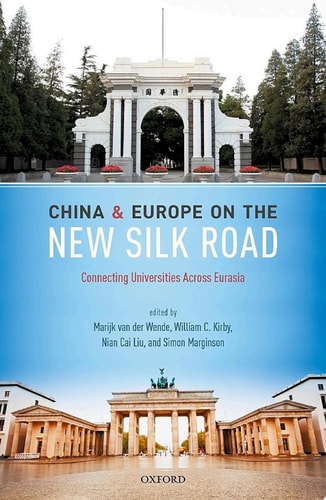
China and Europe on the New Silk Road: Connecting Universities Across Eurasia
0
0
As an Amazon Associate and affiliate partner, Menrva Books earns from qualifying purchases. Learn more
Author Description
The global order, based on international governance and multilateral trade mechanisms in the aftermath of the Second World War, is changing rapidly and creating waves of uncertainty. This is especially true in higher education, a field increasingly built on international cooperation and the free movement of students, academics, knowledge, and ideas. Meanwhile, China has announced its plans for a "New Silk Road" (NSR) and is developing its higher education and research systems at speed. In this book an international and interdisciplinary group of scholars from Europe, China, the USA, Russia, and Australia investigate how academic mobility and cooperation is taking shape along the New Silk Road and what difference it will make, if any, in the global higher education landscape. Opening chapters present the global context for the NSR, the development of Chinese universities along international models, and the history and outcomes of EU-China cooperation. The flows and patterns in academic cooperation along the NSR as they shape and have been shaped by China's universities are then explored in more detail. The conditions for Sino-foreign cooperation are discussed next, with an analysis of regulatory frameworks for cooperation, recognition, data, and privacy. Comparative work follows on the cultural traditions and academic values, similarities, and differences between Sinic and Anglo-American political and educational cultures, and their implications for the governance and mission of higher education, the role of critical scholarship, and the state and standing of the humanities in China. The book concludes with a focus on the "Idea of a University"; the values underpinning its mission, shape, and purpose, reflecting on the implications of China's rapid higher education development for the geo-politics of higher education itself.
Menrva's Summary
THE THESIS
This book investigates how China's 'New Silk Road' initiative and its rapid expansion of higher education are reshaping academic mobility, cooperation, and the global landscape of universities across Eurasia. The authors, a team of international scholars led by Marijk van der Wende, Nian Cai Liu, and William C. Kirby, utilize a multidisciplinary approach to analyze the intersection of geopolitical strategy and institutional development. By examining regulatory frameworks, cultural traditions, and the evolving mission of universities, the text provides a comprehensive framework for understanding the shifting dynamics of knowledge exchange between China and Europe.
THE SCOPE MAP
What You Will Find
- Analysis of the 'New Silk Road' initiative's impact on academic mobility.
- Comparative studies of Sinic and Anglo-American educational values and governance.
- Examination of regulatory frameworks, data privacy, and cooperation protocols.
- Historical context of EU-China academic partnerships.
Scope Limits
- The text does not provide a comprehensive history of all individual Chinese universities.
- It does not offer a predictive model for future geopolitical outcomes beyond the current higher education landscape.
THE AUTHORITY PERSPECTIVE
Experts identify this work as a foundational text for understanding the intersection of international policy and higher education development. Readers frequently note the academic density of the prose, which provides a rigorous analysis suitable for policymakers and scholars in the field of global education.
Page Count:
448
Publication Date:
2020-01-01
Publisher:
OUP Oxford
ISBN-10:
0192594508
ISBN-13:
9780192594501
China Studies
Geopolitics
International business
Consumer Education
Organization Development
Education
International relations
Higher Education
Community Tags
Similar Books