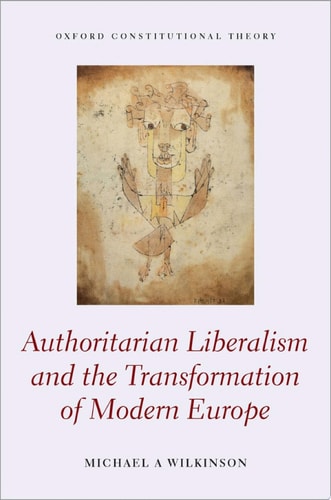
Authoritarian Liberalism and the Transformation of Modern Europe
0
0
As an Amazon Associate and affiliate partner, Menrva Books earns from qualifying purchases. Learn more
Author Description
This title recounts the transformation of Europe from the post-war era until the Euro-crisis, using the tools of constitutional analysis and critical theory. The central claim is twofold: Europe has been gradually reconstituted in a manner that combines political authoritarianism with economic liberalism and that this order is now in a critical condition. Authoritarian liberalism is constructed supranationally, through a taming of inter-state relations in the project of European integration; at the domestic level, through the depoliticization of state-society relations; and socially, through the emergence of a new constitutional imaginary based on liberal individualism. In the language of constitutional theory, this transformation can be captured by the substitution of supranationalism for internationalism, technocracy for democracy, and economic for political freedom. Sovereignty is restrained, democracy curtailed, and class struggle repressed. This constitutional trajectory takes time to unfold and develop and it presents continuities and discontinuities. On the one hand, authoritarian liberalism is deepened by the neoliberalism of the Maastricht era and the creation of Economic and Monetary Union. On the other hand, counter-movements then also begin to emerge, geopolitically, in the return of the German question, domestically, in the challenges to the EU presented by constitutional courts, and informally, in the rise of anti-systemic political parties and movements. Sovereignty, democracy, and political freedom resurface, but are then more actively suppressed through the harsher authoritarian liberalism of the Euro-crisis phase. This leads now to an impasse. Anti-systemic politics return but remain uneasily within the EU, suggesting authoritarian liberalism has reached its limits if just about managing to maintain constitutional order. As yet, there has been no definitive rupture, with the possible exception of Brexit.
Menrva's Summary
THE THESIS
This book investigates the emergence of authoritarian liberalism as the defining constitutional framework of modern Europe and its subsequent crisis. Michael A. Wilkinson, a scholar of law and political theory, utilizes a framework of constitutional analysis and critical theory to examine the evolution of the European Union from the post-war period to the present. He argues that the integration process has systematically replaced democratic processes with technocratic governance, effectively insulating economic liberalism from political contestation.
THE SCOPE MAP
What You Will Find
- Analysis of the transition from internationalism to supranationalism in European governance.
- Examination of the Maastricht era and the establishment of the Economic and Monetary Union.
- Theoretical exploration of the depoliticization of state-society relations.
- Discussion of the rise of anti-systemic political movements and the role of constitutional courts.
Scope Limits
- The text focuses primarily on the constitutional and theoretical dimensions of the EU rather than providing a comprehensive economic history of the Euro-crisis.
- It does not offer a predictive model for the future of the European Union beyond identifying the current impasse.
THE AUTHORITY PERSPECTIVE
Scholars in the fields of European law and political science frequently cite this work for its rigorous critique of the democratic deficit within the European project. Readers often note the academic density of the prose, which requires a foundational understanding of constitutional theory to fully engage with the author's arguments.
Page Count:
352
Publication Date:
2021-01-01
Publisher:
OUP Oxford
ISBN-10:
0192597086
ISBN-13:
9780192597083
Economics
Professional Career & Trade
Constitutional Law
European History
Sociology
Political Theory
Community Tags
Other Editions(2)
Similar Books

Reader Comments
Share Your Thoughts
No comments yet. Be the first to share your thoughts!