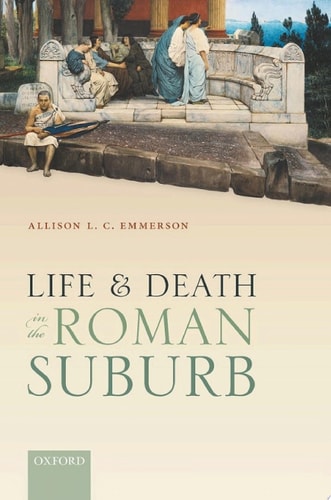
Life and Death in the Roman Suburb
0
0
As an Amazon Associate and affiliate partner, Menrva Books earns from qualifying purchases. Learn more
Author Description
Defined by borders both physical and conceptual, the Roman city stood apart as a concentration of life and activity that was legally, economically, and ritually divided from its rural surroundings. Death was a key area of control, and tombs were relegated outside city walls from the Republican period through Late Antiquity. Given this separation, an unexpected phenomenon marked the Augustan and early Imperial periods: Roman cities developed suburbs, built-up areas beyond their boundaries, where the living and the dead came together in densely urban environments. Life and Death in the Roman Suburb examines these districts, drawing on the archaeological remains of cities across Italy to understand the character of Roman suburbs and to illuminate the factors that led to their rise and decline, focusing especially on the tombs of the dead. Whereas work on Roman cities has tended to pass over funerary material, and research on death has concentrated on issues seen as separate from urbanism, Emmerson introduces a new paradigm, considering tombs within their suburban surroundings of shops, houses, workshops, garbage dumps, extramural sanctuaries, and major entertainment buildings, in order to trace the many roles they played within living cities. Her investigations show how tombs were not passive memorials, but active spaces that facilitated and furthered the social and economic life of the city, where relationships between the living and the dead were an enduring aspect of urban life.
Menrva's Summary
THE THESIS
This book investigates how the Roman suburb functioned as a complex, integrated urban space where the living and the dead coexisted, challenging the traditional view that funerary sites were strictly separated from city life. Dr. Allison L. C. Emmerson, an expert in Roman archaeology, utilizes archaeological evidence from various Italian cities to argue that tombs were active, functional components of the urban landscape rather than passive memorials. By analyzing the proximity of tombs to shops, workshops, and entertainment venues, she presents a framework that redefines the relationship between urban development and funerary practices during the Augustan and early Imperial periods.
THE SCOPE MAP
What You Will Find
- Archaeological analysis of suburban districts across Italy.
- Examination of the spatial relationship between tombs and commercial or residential structures.
- Discussion of the socio-economic roles played by extramural spaces.
Scope Limits
- The study focuses primarily on the Republican period through Late Antiquity.
- It does not provide a comprehensive survey of all Roman provinces, concentrating instead on Italian urban centers.
THE AUTHORITY PERSPECTIVE
Scholars and archaeologists recognize this work as a significant shift in the study of Roman urbanism by successfully integrating funerary archaeology into the broader discourse on city development. Readers frequently note the academic density of the prose and the author's meticulous use of site-specific evidence to support her new paradigm.
Page Count:
300
Publication Date:
2020-01-01
Publisher:
OUP Oxford
ISBN-10:
0192594109
ISBN-13:
9780192594105
History
Roman History
Urban Studies
Ancient History
Archaeology
Italy history
Social History
Community Tags
Similar Books