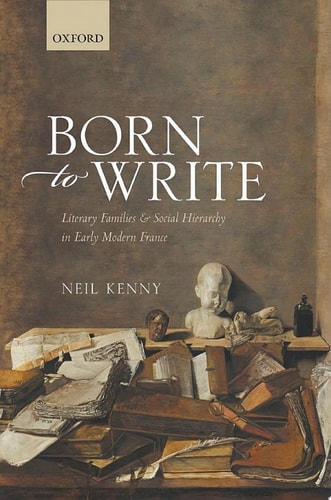
Born to Write: Literary Families and Social Hierarchy in Early Modern France
0
0
As an Amazon Associate and affiliate partner, Menrva Books earns from qualifying purchases. Learn more
Author Description
It is easy to forget how deeply embedded in social hierarchy was the literature and learning that has come down to us from the early modern European world. From fiction to philosophy, from poetry to history, works of all kinds emerged from and through the social hierarchy that was a fundamental fact of everyday life. Paying attention to it changes how we might understand and interpret the works themselves, whether canonical and familiar or largely forgotten. But a second, related fact is much overlooked too: works also often emanated from families, not just from individuals. Families were driving forces in the production--that is, in the composing, editing, translating, or publishing--of countless works. Relatives collaborated with each other, edited each other, or continued the unfinished works of deceased family members; some imitated or were inspired by the works of long-dead relatives. The reason why this second fact (about families) is connected to the first (about social hierarchy) is that families were in the period a basic social medium through which social status was claimed, maintained, threatened, or lost. So producing literary works was one of the many ways in which families claimed their place in the social world. The process was however often fraught, difficult, or disappointing. If families created works as a form of socio-cultural legacy that might continue to benefit their future members, not all members benefited equally; women sometimes produced or claimed the legacy for themselves, but they were often sidelined from it. Relatives sometimes disagreed bitterly about family history, identity (not least religious), and so about the picture of themselves and their family that they wished to project more widely in society through their written works, whether printed or manuscript. So although family was a fundamental social medium out of which so many works emerged, that process could be conflictual as well as harmonious. The intertwined role of family
Menrva's Summary
THE THESIS
This book investigates how the production of literature in early modern France functioned as a mechanism for families to establish, negotiate, and maintain their position within the rigid social hierarchy of the period. Neil Kenny, a scholar of early modern French culture, utilizes a wide array of primary sources—including manuscripts, printed works, and family records—to argue that literary creation was rarely an individual endeavor but rather a collective family project intended to secure socio-cultural legacy and status.
THE SCOPE MAP
What You Will Find
- Analysis of collaborative literary production including editing, translating, and publishing within kinship networks.
- Examination of how family identity and religious affiliation influenced the content and projection of written works.
- Discussion of gender dynamics and the marginalization of women within family-based literary legacies.
Scope Limits
- The study focuses specifically on early modern France and does not provide a comparative analysis of other European literary traditions.
- The text does not offer a comprehensive survey of all literary genres but selects representative works to illustrate the socio-familial framework.
THE AUTHORITY PERSPECTIVE
Scholars recognize this work as a significant contribution to the social history of literature, noting its ability to bridge the gap between textual analysis and historical sociology. Readers frequently highlight the academic density of the prose and the author's meticulous attention to the intersection of kinship structures and intellectual production.
Page Count:
432
Publication Date:
2020-01-01
Publisher:
OUP Oxford
ISBN-10:
0192593579
ISBN-13:
9780192593573
History
English & College Success
Social History
Literary Criticism
Industries history
Families
English
Authors French
Early Modern
Sociology of Literature
Community Tags
Similar Books